Editor’s Note: This post is written by a member of LTV’s sponsored content team, The Leisure Explorers. Do you own a Leisure Travel Van and enjoy writing? Learn more about joining the team.
Golden Spike National Historical Park Preserves and Relives History
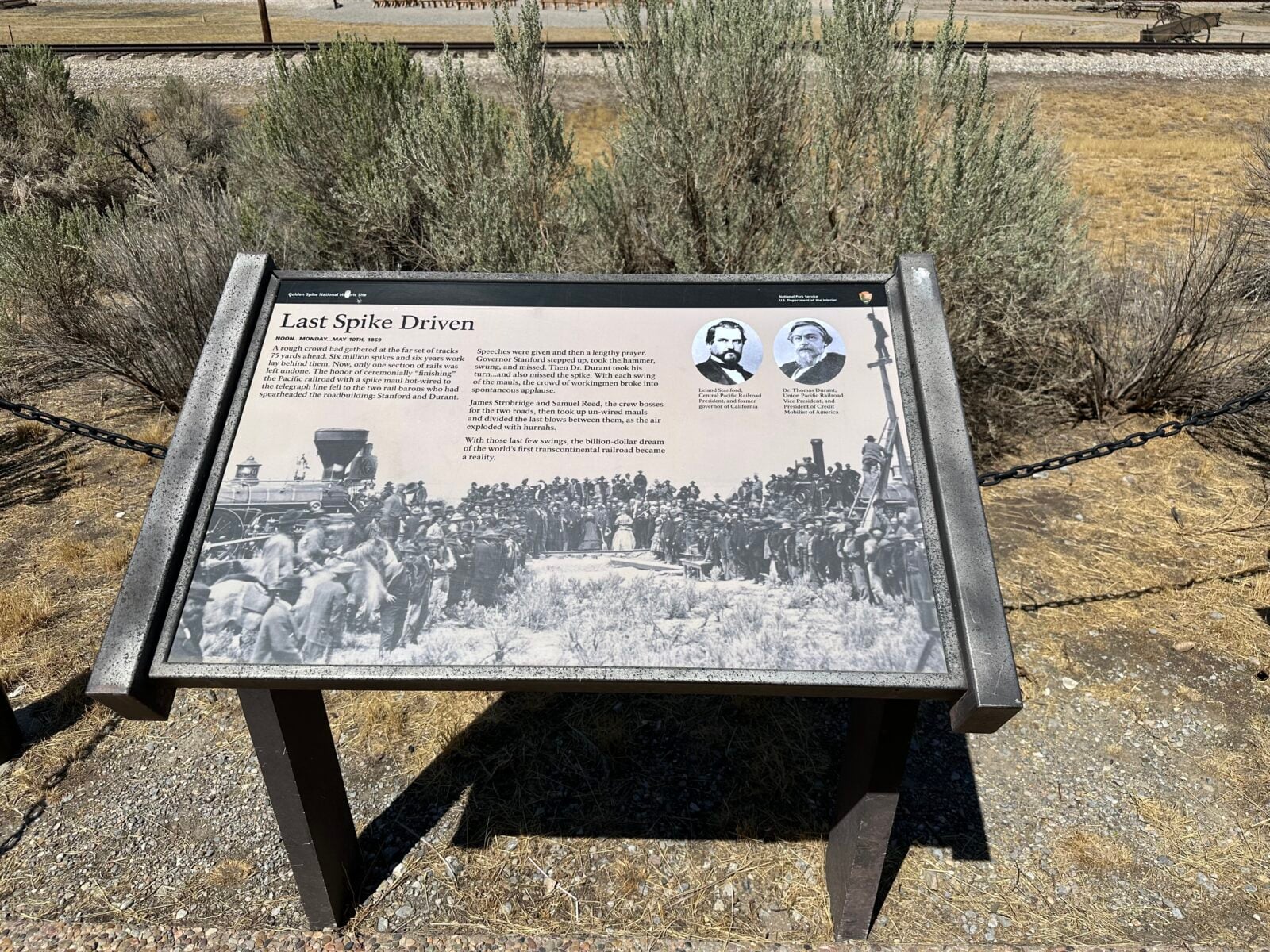
On May 10, 1869, the temporary residents of a tent settlement named Promontory, Utah, saw history being made. No one knows how many, but it’s said that from 500 to 3,000 were present when a solid gold railroad spike was ceremonially “driven” into a laurel wood tie.
It was a moment that literally united the United States by steel rails from east to west. Canada’s turn came in 1885. It happened just four short years after the carnage of the US Civil War ended. Just eight before the carnage at the Little Bighorn, 21 before Wounded Knee.
When you travel the west, it’s a one-hour or three-hour stop that you can easily, and should, visit at this now lonely spot in the high desert of Utah, about 66 miles northwest of Salt Lake City, and about an hour drive from Interstate 15.
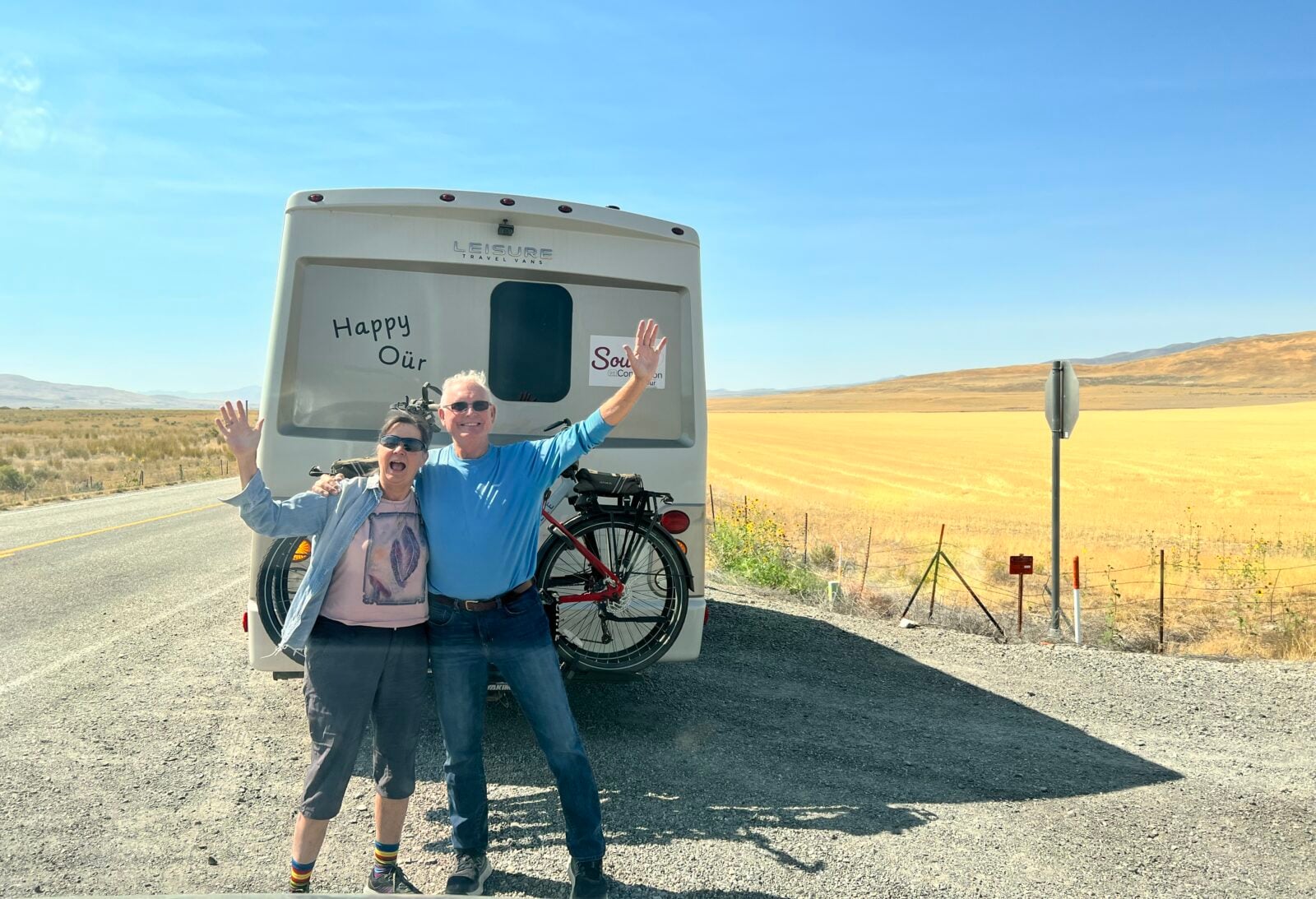
We joined fellow LTV owners Bob Freese and Peggy Schaefer on this little detour to Promontory to experience Golden Spike National Historic Park during a multi-stop trip that included a revisit to Bryce Canyon National Park, a drive-by of Capitol Reef National Park, and a staggeringly spectacular trip over Grand Staircase-Escalante National Monument.
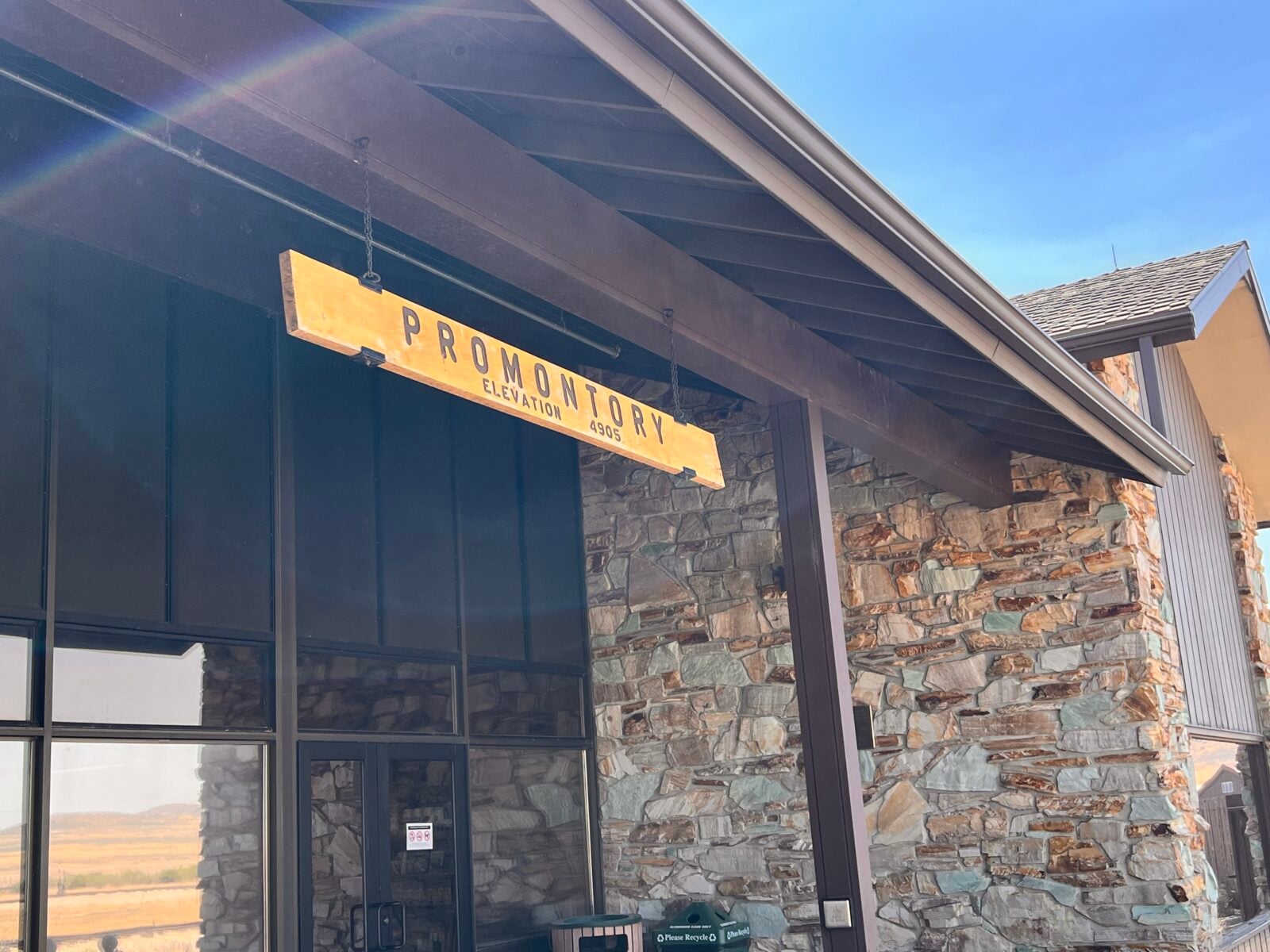
Promontory, at an elevation of 5000 feet, was a bustling tent city in the 1860s. Learning the story of joining the country with that famous golden spike, which meant the United States could now be traversed in seven days instead of four months, is a short stop worth your time.
First, why this dry hilly spot? Two reasons: both the Central Pacific Railroad, after coming from the west and nearly becoming bankrupt before finally breaking through the Sierra Nevada Mountains in California, and the Union Pacific, having a much easier time laying track starting in Omaha, Nebraska, were cheating. Both knew they’d earn more US government money by building more track, and deliberately passed each other by 20 miles to do so, nearby, actually building railroad beds within sight of each other. Congress finally stepped in, saying not so fast, you’re going to join at Promontory.
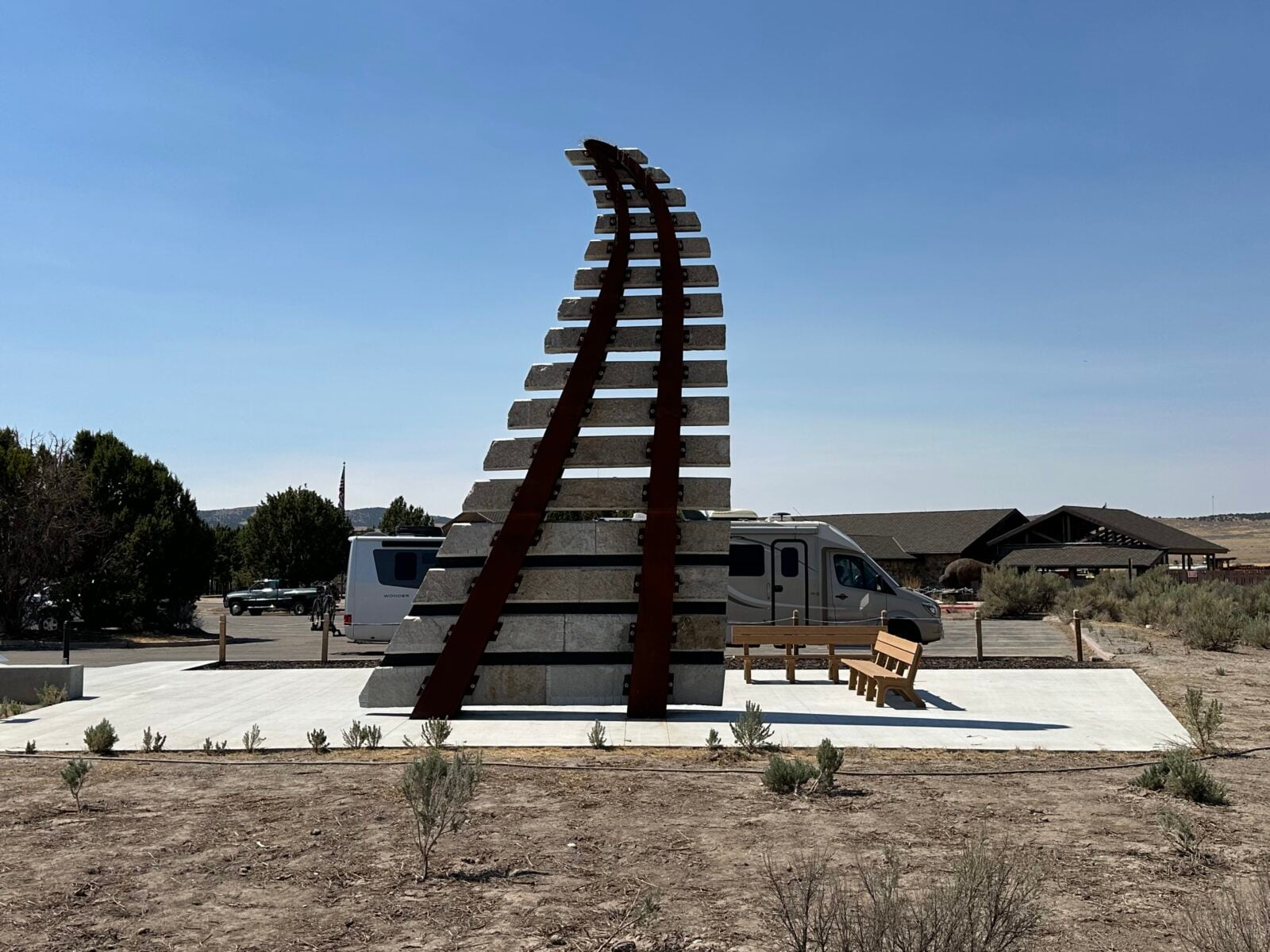
You’ll learn all about that and other facts at the visitor center, which is at the exact spot at Promontory Summit where the joining ceremony took place. The center is beside a set of railroad tracks, where you’ll also see two CP and UP steam locomotives that are exact replicas of the originals appearing in the famous photo that nearly everyone in the US has seen—more on that in a bit.
Before you arrive, you’ll pass historical markers and a turn-off where cars can drive a seven-mile portion of the original 1869 railroad grade before arriving at the visitor center. But can RVs? A sign said no, so we didn’t. Besides, we had an overnight date with a Harvest Host location near Salt Lake, so we headed to the center instead.
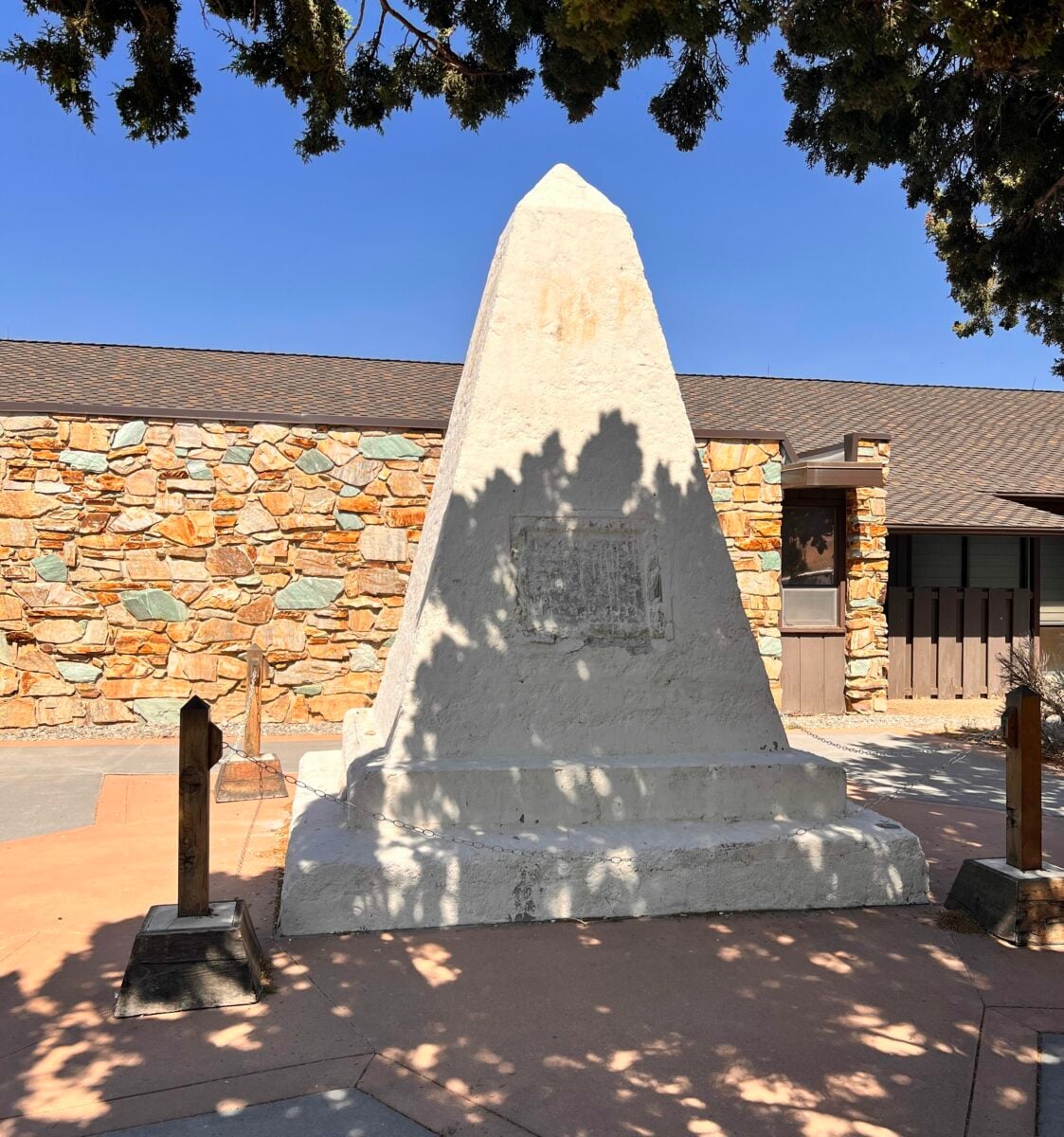
Outside, a chalky obelisk is the original historic marker denoting the point where the two railroads met. It’s near another monument, that one to the buffalo, or American bison, which were slaughtered by the hundreds of thousands to feed work crews laying the steel, and also to make money on their hides and curiously, buffalo tongues, also sold as a food delicacy. Later, the railroad would figure in the mass killing of buffalo, nearly to extinction.
Walk in and start exploring. It’s a visual learner’s dream, including a replica of that golden spike. The original, ceremonially pounded in—but very gently—by Leland Stanford, president of the Central Pacific and then-California governor, was immediately removed after the ceremony. But we’re getting ahead.
The railroad dream was actually launched during the Civil War by President Lincoln in 1862 when he signed the construction bill into law. Among the exhibits, one shows the evolution of the rail itself, from 1869 to 1969.
Immigrants Built It
What’s perhaps most striking inside exhibits are two showing what the rails and ties looked like, and another on who actually built it—thousands upon thousands of immigrants, both Irish and Chinese.
Chinese workers were paid 30 percent less than white workers by the Central Pacific and went on strike in 1867 because of it. At the time, it was the largest organized strike in the country. The railroad cut off all food and water, and the workers went back after a week, but their point had been made. Later, the company quietly raised wages. Irish, fresh out of the Union Army, joined the Union Pacific. Today, descendants of those workers gather at Promontory to celebrate their work in building the United States during events like the 150th anniversary, which took place in 2019.
You might also want to view the short video at the center about the build, and the place where you can see the two railroad beds paralleling each other until Congress said, stop it.
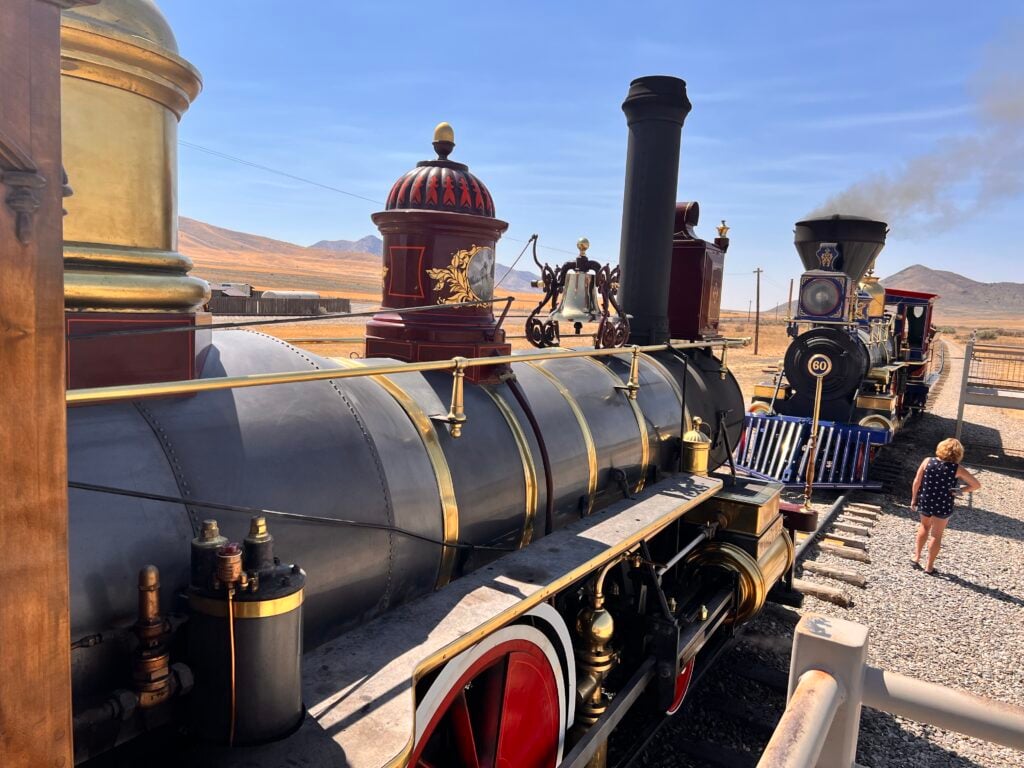
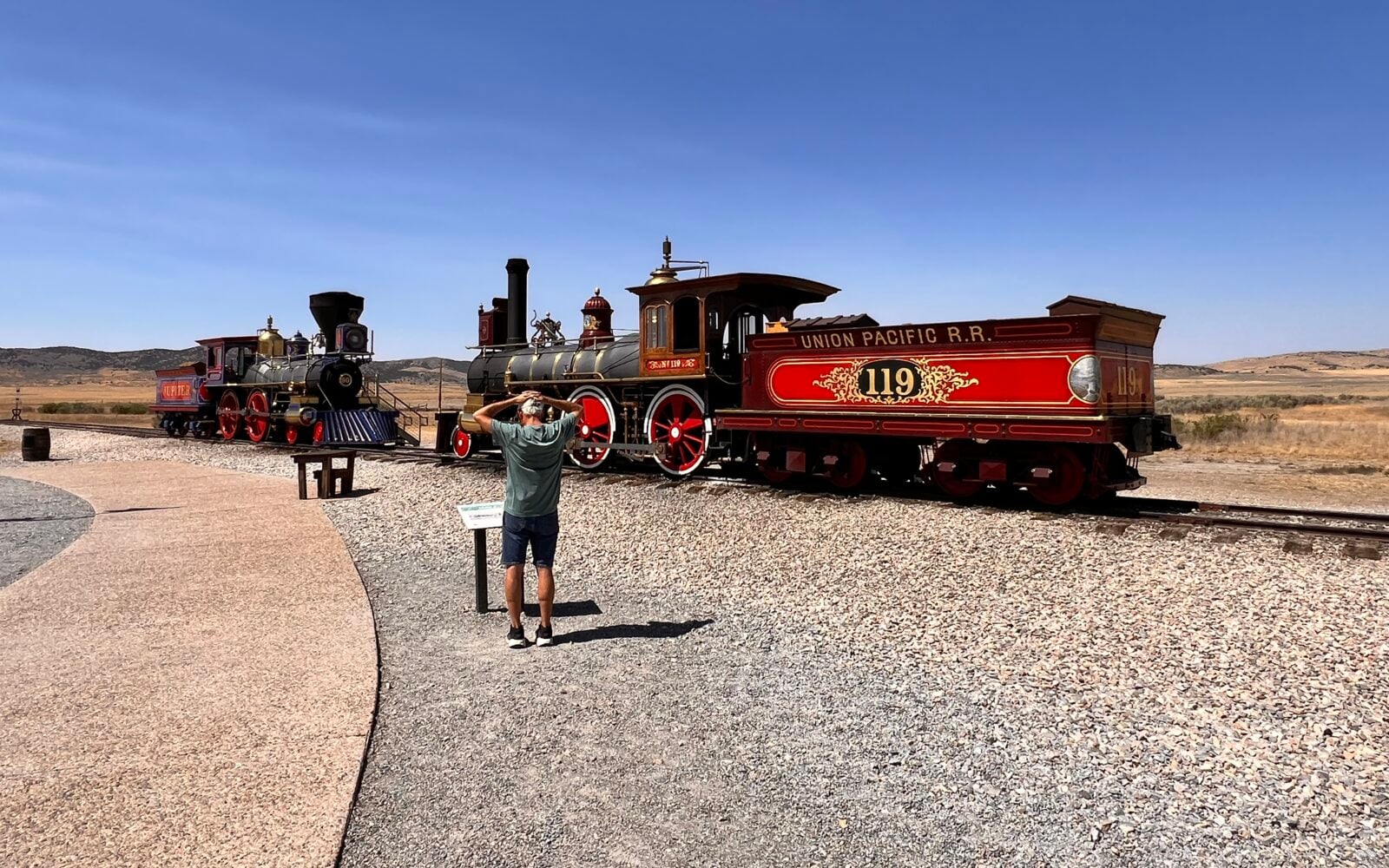
Now, step outside. If it’s time—usually twice daily, at 11 am and 1 pm—you’re in for a treat. You’re about to witness a semi-reenactment of the event. Two exact replicas of steam locomotives, one from the Central and one from the Union Pacific, stand puffing and occasionally “blowing off steam,” hence the expression, face each other on tracks built near the original site.
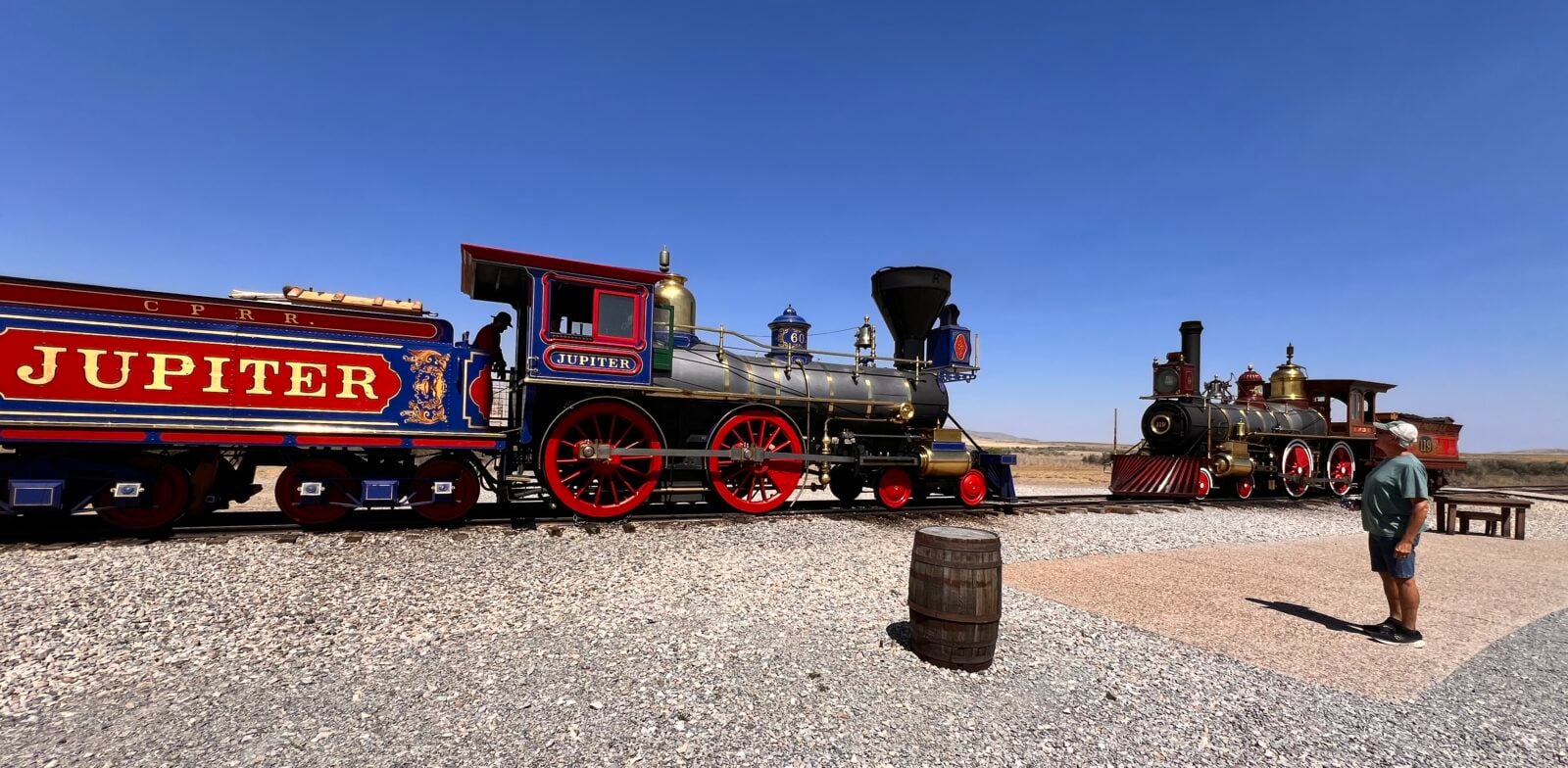
One, with that big spark arrestor stack because it burned wood, which was plentiful in the west, the CPRR named “Jupiter.” The other was known as Union Pacific No. 119. It burned coal, which was plentiful in the East, and these two do as well.
Walk up to both and climb a platform next to the cabs to look inside at the engineer and “fireman” next to him. Firemen stoked the fires when steam ruled the rails, and both will be in dress authentic to the photo taken when the two original engines ceremonially “met.”
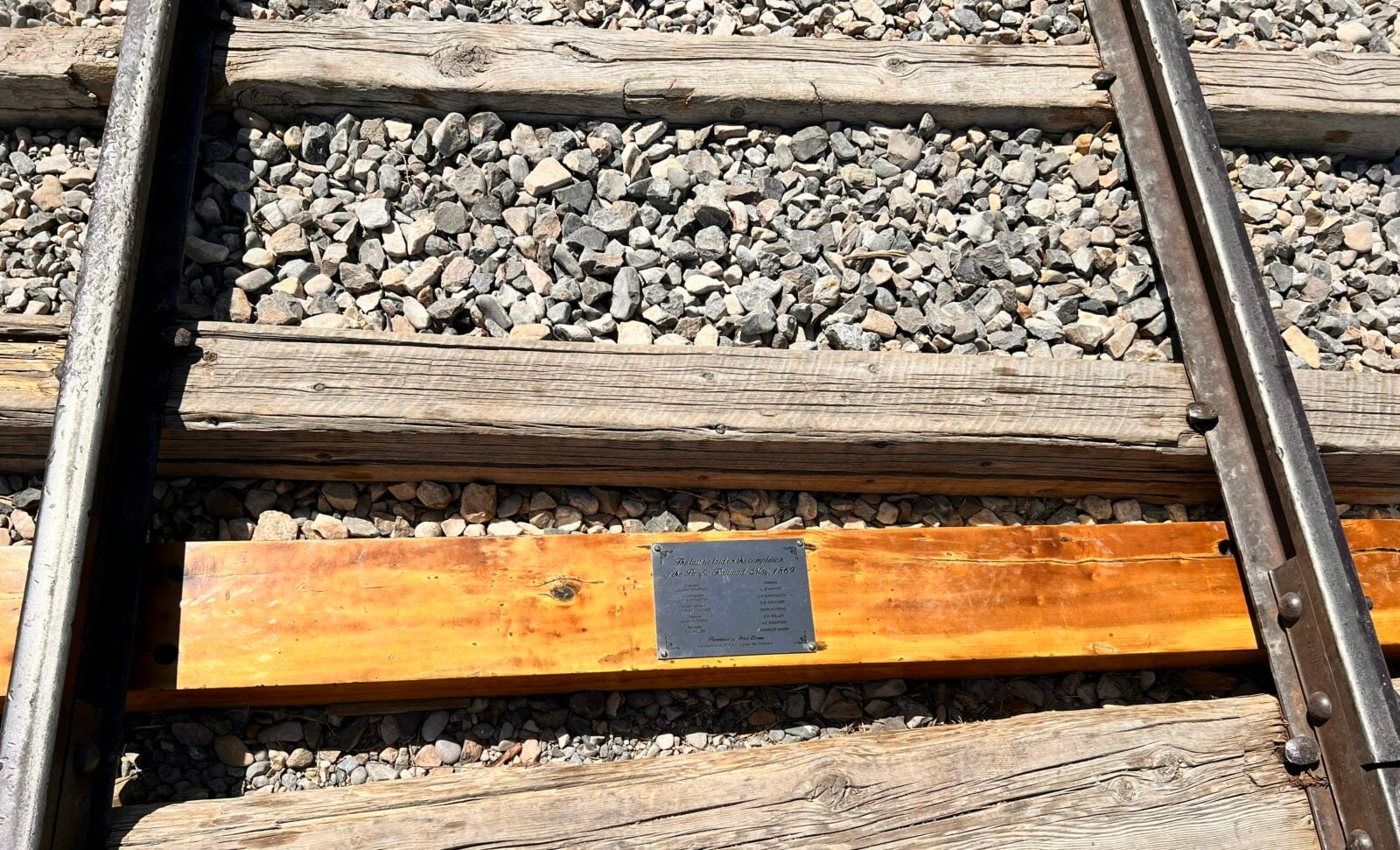
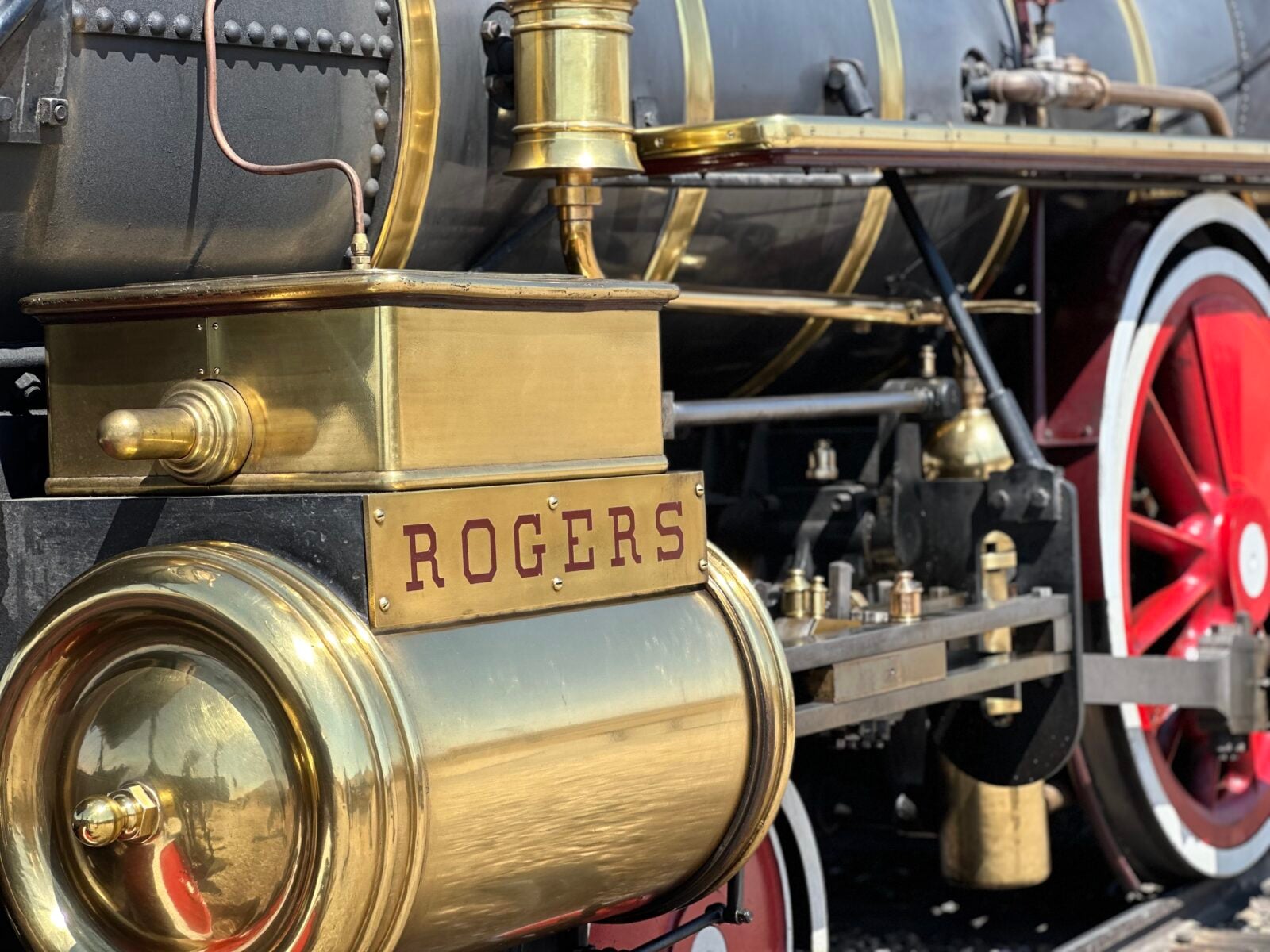
Then watch as the two, looking like they just rolled out of the locomotive works that made the originals in New York and New Jersey, pant in reverse down the tracks, steam hissing, driver wheels on the 4-4-0 locomotives churning, pausing maybe a ¼ mile away. Then rumbling forward with whistles wailing, they slow, then stop, cow catcher to cow catcher to depict what it was like on that day in May, 1869, to figuratively unite the United States. It was signaled to the young country by a telegraph message that simply read: D-O-N-E.
An actual depiction of the event, replete with a spike-driving re-enactment, takes place annually on May 10.
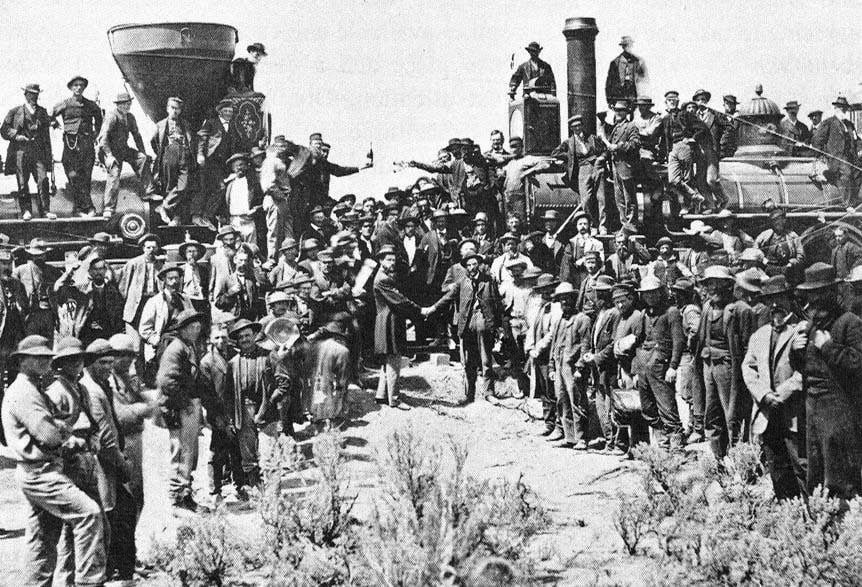
At the site of one of the 19th century’s most monumental engineering feats, nothing else remains. The stark high desert stretches to the horizon.
When You Go
Who built those replicas anyway? It took the artists at the Walt Disney Studios two years to design them, following detailed measurements from old engineering books and photographs, as no blueprints remained. After all, they designed the locomotives at Disneyland and Disney World, so why not? Building them at O’Connor Engineering of Costa Mesa, CA, took another two years. They went into service on May 10, 1979, the 110th anniversary.
The term 4-4-0 refers to their wheel configuration: four front trucks, four driver wheels (two on each side), and no rear trucks.
Where’s the original golden spike? On display at Stanford University’s (yup, named after the hammer-slinging governor) Cantor Arts Center.
Golden Spike National Historical Park is open Thursday–Monday, 9:00 a.m. – 5:00 p.m. (closed Tuesday/Wednesday) from late-October to late-April, and daily (9:00 am– 5:00 pm) from summer/fall. If you want to drive your LTV on the original rail bed, ask before you get on it, as it may not be a good idea, like the sign warns.
This is a companion discussion topic for the original entry at https://leisurevans.com/blog/shortstop-uniting-the-united-states-at-promontory-utah/