Editor’s Note: This post is written by a member of LTV’s sponsored content team, The Leisure Explorers. Do you own a Leisure Travel Van and enjoy writing? Learn more about joining the team.
In Dean’s video about the 2025 Wonder Rear Twin Bed, he excitedly describes that the 540 amp-hours of lithium and 3000-watt pure sine wave inverter enable the Truma Aventa 13,500 BTU air conditioner to run off the batteries, which can be recharged using 400-watt solar panels or the 4-kilowatt generator, which enables 150 amps of charging. If Dean gets excited about running an air conditioner in Canada, you can imagine how exciting it is for those who live on the Gulf Coast!
When we picked up our new Wonder in April 2025, we knew we had a lot to learn, as this was our first motorhome. However, with dry camping in our plans, one question was whether the air conditioner would run through the night on batteries. As a tent camper, nearby generators have kept me awake, and I wished to avoid running mine at night and disturbing others. Also, I was unsure how to sleep in the LTV with my generator running.
In the post below, I describe how I measured battery usage and charging to understand the Wonder’s systems, enabling me to answer whether we could run our air conditioner all night on battery. The short answer to the question was, “It depends.” I ran the air conditioner on batteries for 8.5 hours in Houston’s August outside temperatures up to 92 degrees Fahrenheit. I have dry-camped multiple times with the air conditioner on battery and had more than 25% remaining in the morning. I started the night in each scenario with well-charged batteries and a cool house. However, I’m not expecting the batteries to be sufficient for overnighting in Death Valley in August! Below, I hope I can help you understand what it depends on. While the test results were useful for understanding, it was the journey of carrying out the tests that greatly helped me appreciate my unit’s capabilities and quirks, giving me the confidence to go dry camping without subjecting my wife to a hot night without air conditioning or keeping me awake with our generator. While different years and models will use different components, the logic of these measurements applies.
Amps and Amp-Hours
For many, the terms Dean uses, like amps, watts, kilowatt-hours, and BTU, will perplex. My discussion focuses on “amps” (A), the electricity flow unit known as current. Battery capacity is measured in amp-hours (Ah), equivalent to one amp flowing for one hour. This is defined at the battery’s voltage, which is 12 V. For example, fully-charged 540 Ah batteries could provide 1 A of current at 12 V for 540 hours, or 54 A of current for 10 hours, or 100 A of current for 5.4 hours. The same logic applies to charging the battery. For instance, it would take 3.6 hours for a fully-depleted battery to charge from 0 to 540 Ah with a charging current of 150 A.
Not all amps are created equal. Amps that come from shore power or the generator are at 120 V. Approximately 1 A at 120 V can be converted by the inverter to 10 A at 12 V, and vice versa. There are system “losses” that I am not exploring, which make the value approximate. This gets confusing! Unless otherwise stated, amps in this post are measured at 12 V. Note that multiplying amps by volts gives power in watts.
How to Measure
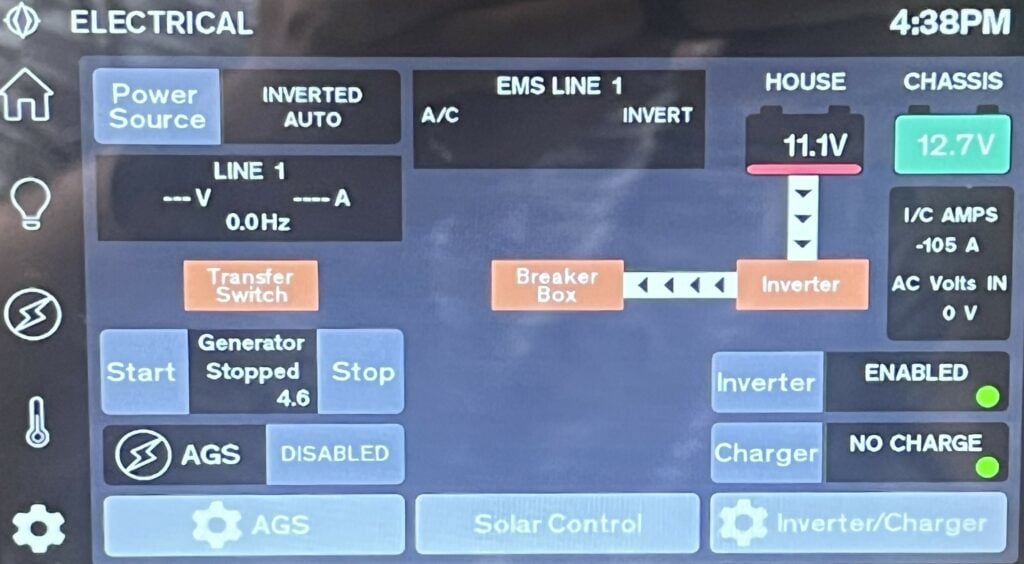
The electrical tab on the Firefly gives insight into the current flow in the motorhome. The information it displays depends on whether power flows out of or into the house battery. In the first example, the motorhome uses neither a generator nor shore power. The inverter is enabled and is drawing 12 A from the house battery.
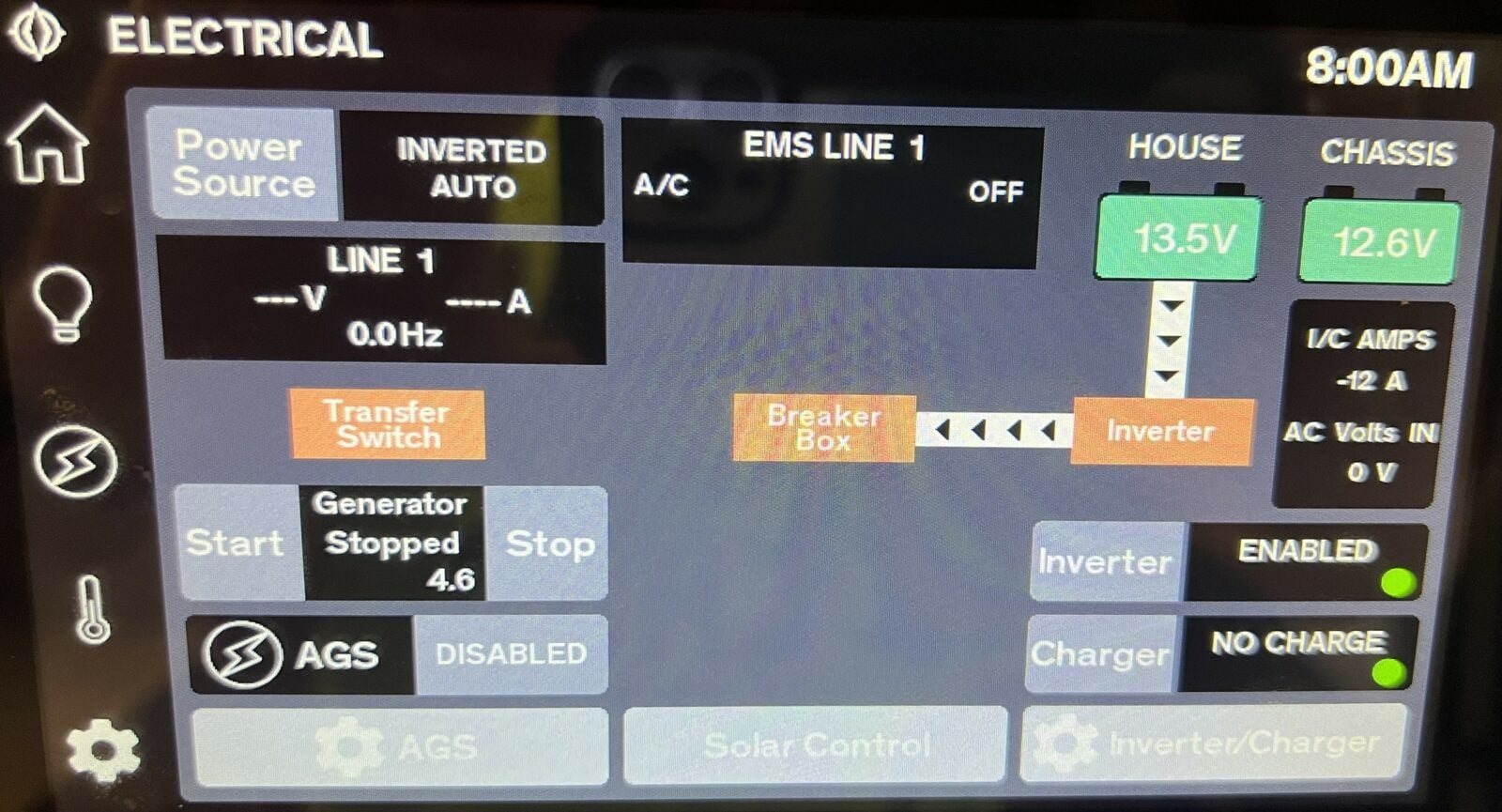
In the second example below, the left-hand side of the screen shows that the generator is supplying 22.0 A at 120 V. The indicators at the bottom right show that this current passes through the inverter (to power 120 V devices) and charges the batteries. The number under “I/C Amps” is the number of amps flowing into or out of the batteries from the inverter. If the number is positive, the current is flowing into (charging) the batteries (as in this example). Conversely, if the number is negative (as in the example above), the current flows out of (discharges) the batteries into the inverter. The actual voltages can vary from their nominal values of 120 V and 12 V. For simplicity in this discussion, I refer to their nominal values. The battery’s voltage depends on the battery’s state of charge and usage state. A load on the battery instantaneously reduces its voltage in addition to discharging the battery, while a charging current instantaneously increases its voltage as well as charging it.
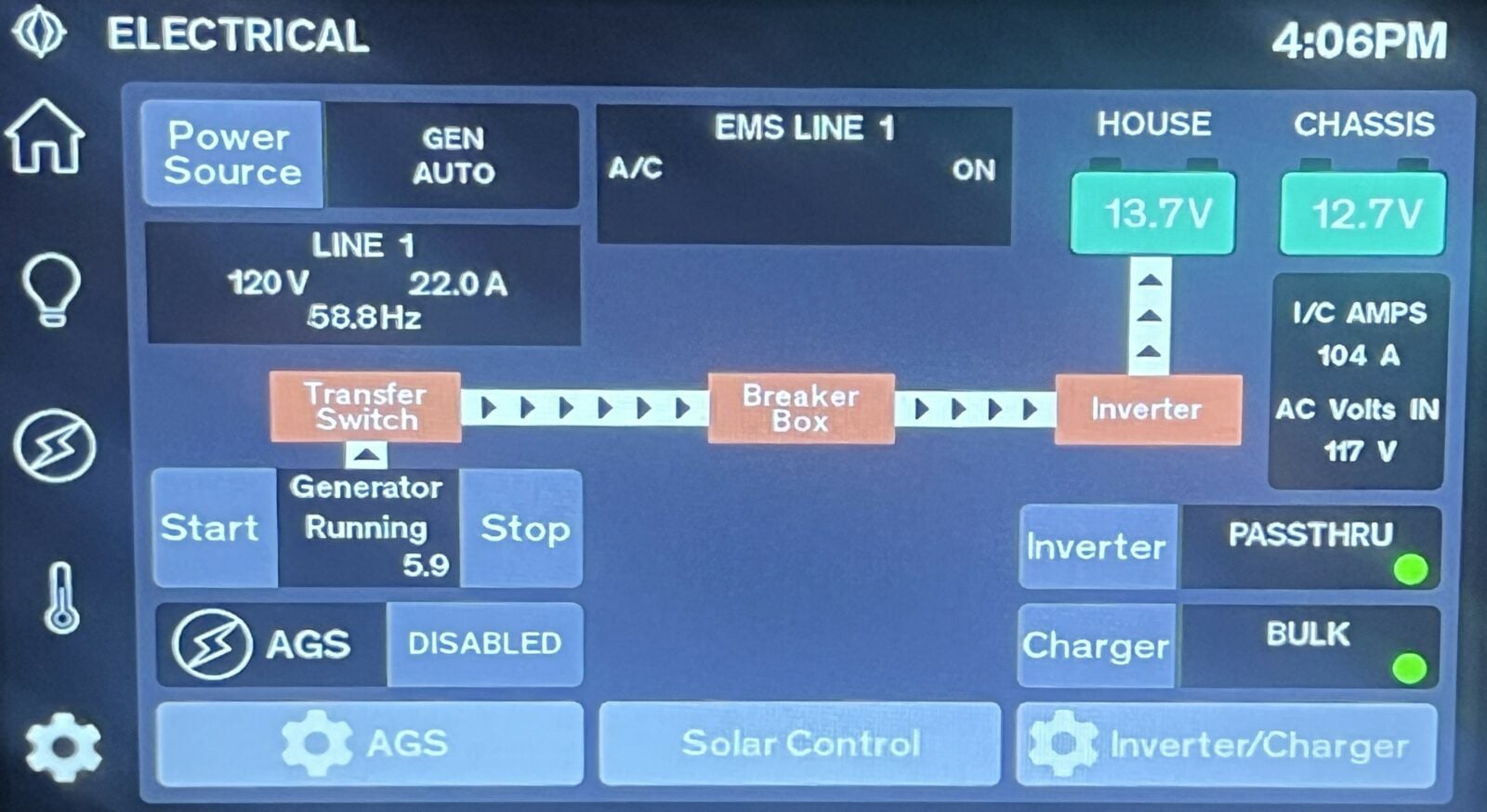
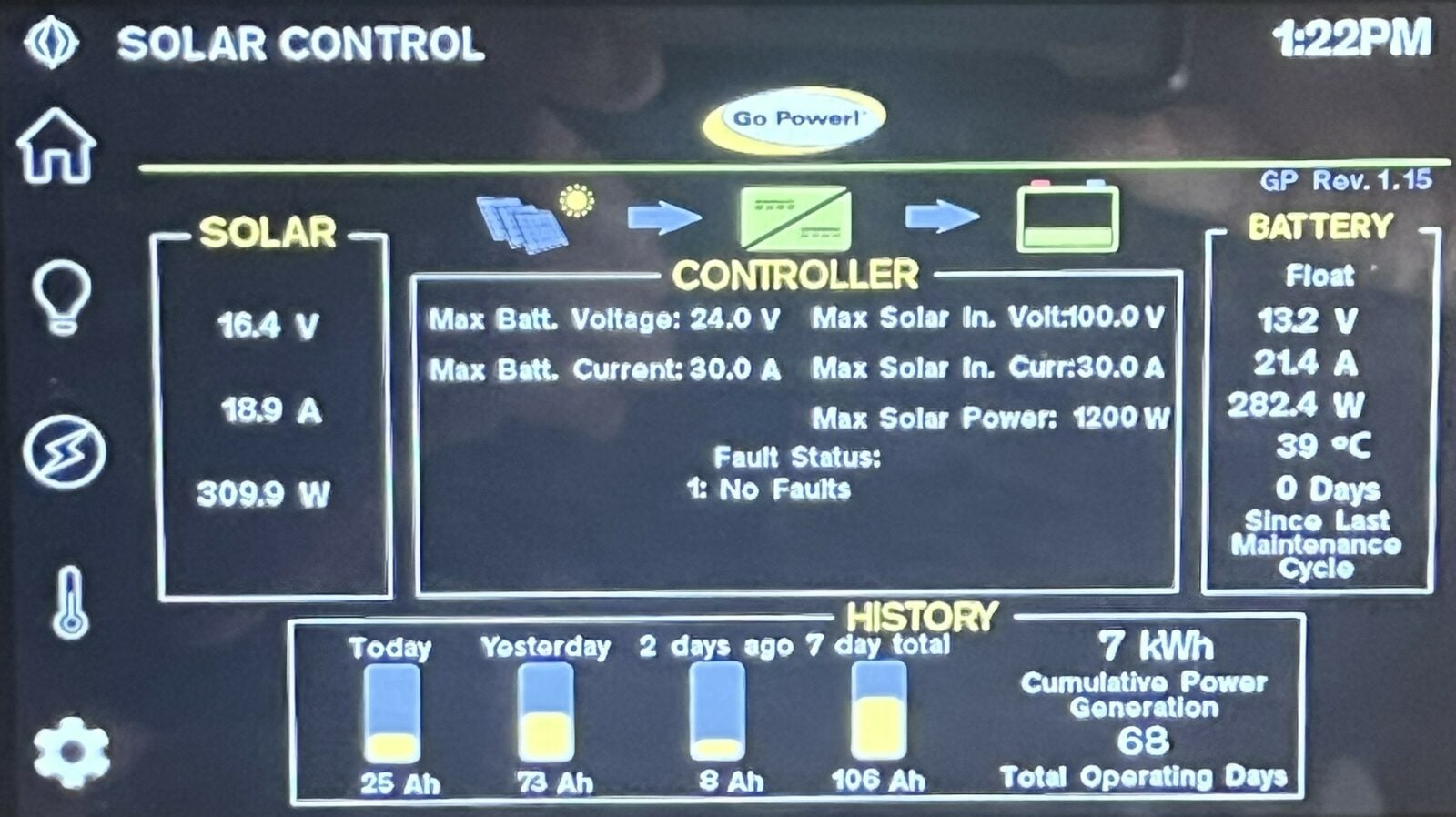
The Firefly’s Solar Control screen gives insight into how much the solar panels charge the batteries. In the example below, the left-hand side shows that the panels are generating 309.9 W of power. The right-hand side shows that it is providing 21.4 A to the batteries. Note that this is less current than the air conditioner uses when cooling, and sunlight heats up the coach. When aiming to cool the coach, it is more effective to park in the shade.
However, the above displays do not tell the whole story as they omit the 12 V circuits that do not pass through the inverter. This is where Battle Born’s phone app is essential, as it measures each battery’s actual current. The example below shows that 58.6 A of current is being drawn from the battery. This is the net amount, accounting for charging currents (e.g., from solar panels, the in-vehicle charger, or from the inverter/charger) and discharging current consumers (12 V systems like the fridge and lights, and what the inverter is using to convert to 120 V). This screen also shows the battery’s State of Charge (SOC) as a percentage and in amp-hours (Ah), and projects how many hours it can continue providing this level of amps until it is fully discharged.
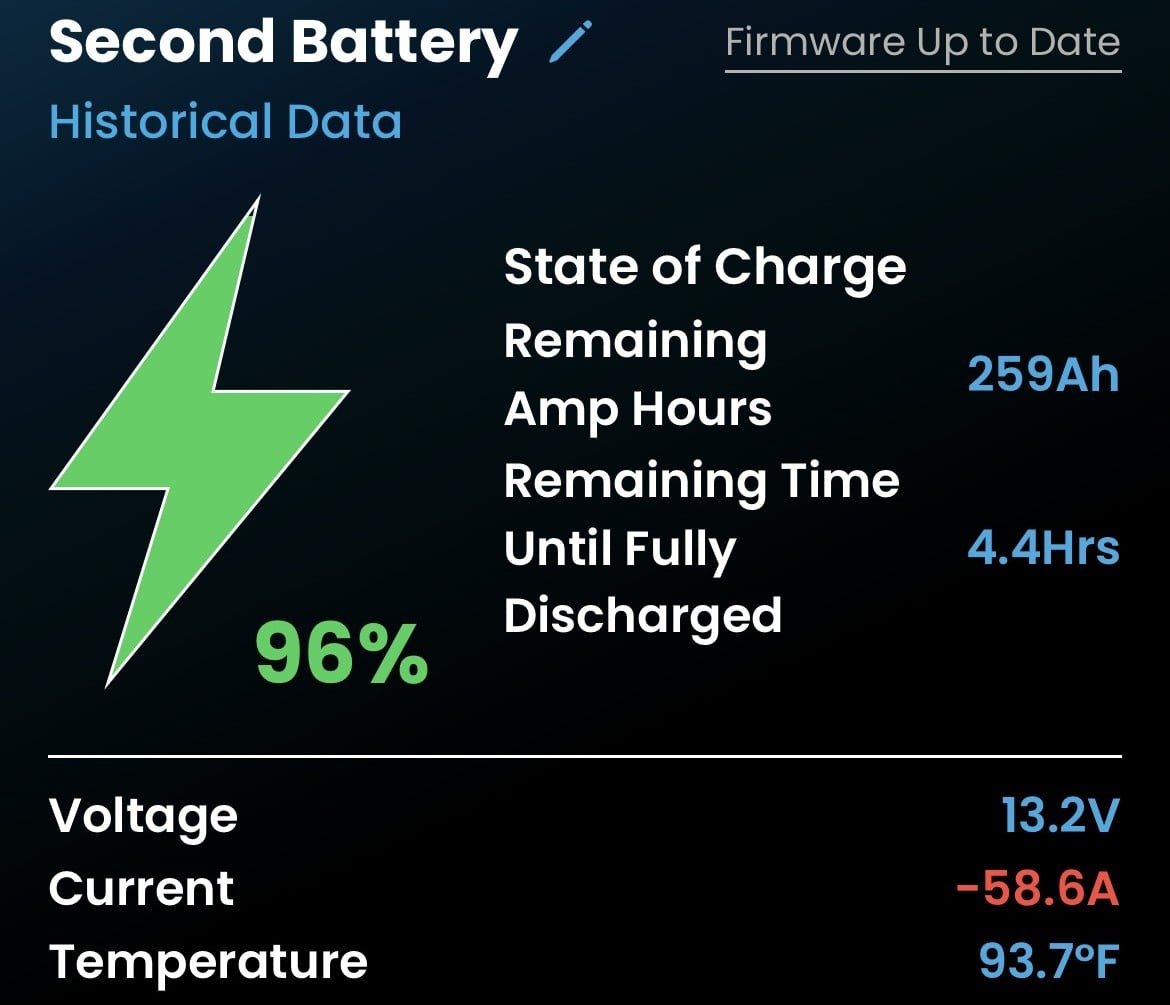
The above measurements provide values at a particular moment. Such values vary over time, especially those associated with cooling devices such as the fridge and air conditioner that turn their cooling compressor on and off depending on the thermostat (known as duty cycle). I took separate measurements for the cooling devices’ high and low power usage. I “eyeballed” all measurements.
The Firefly screens and the Battle Born app provided sufficient measurements for my tests, estimating the system’s current draws. LTV has recorded multiple videos of the Firefly screen and the Battle Born app, which are available in the MyLTV section of their website.
System Summary
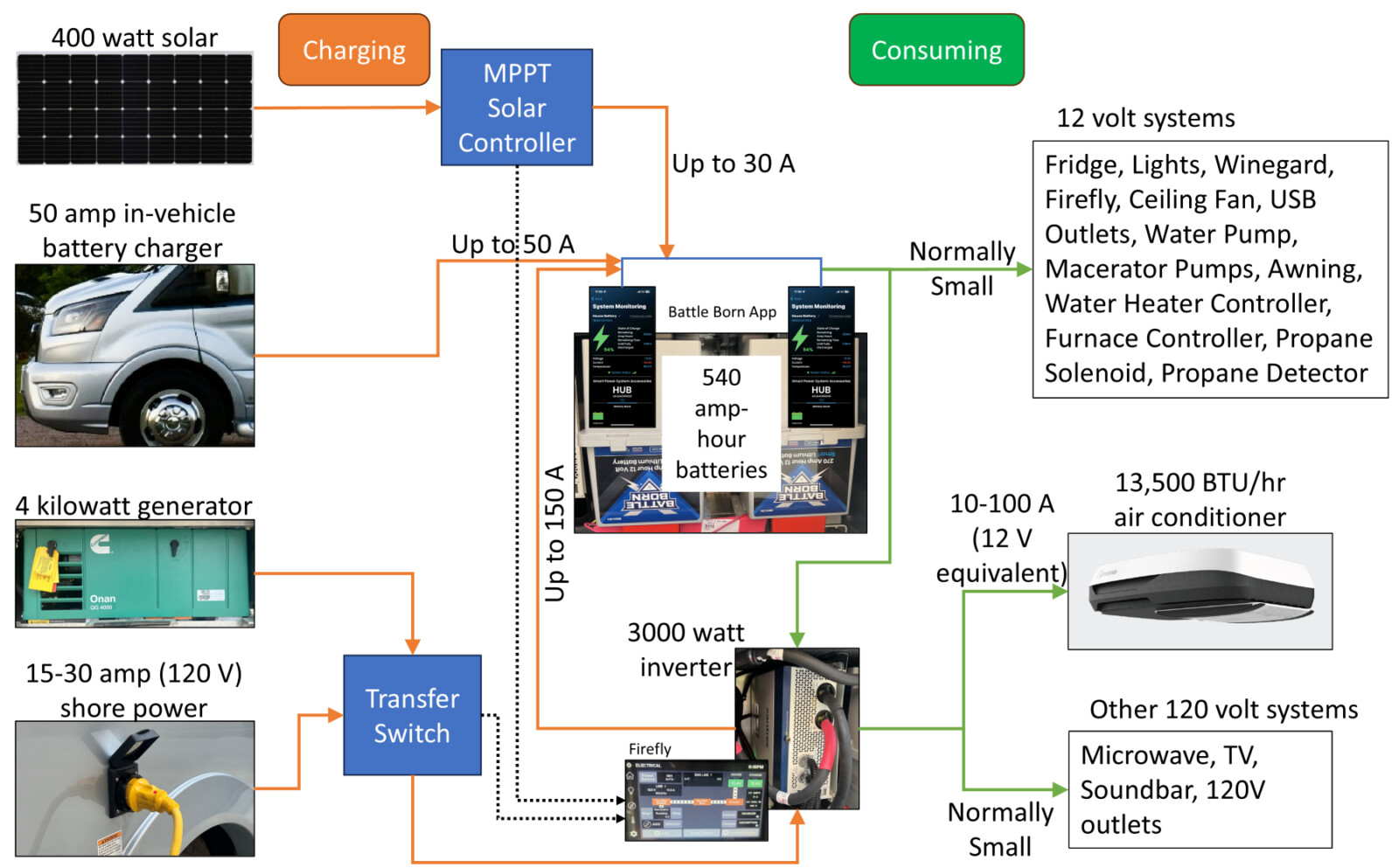
With so many components in the electrical system, it can quickly get confusing. The diagram below represents the components to help explain the answer to the initial question. In the middle are the house batteries with the Battle Born monitoring app. Below the batteries is the inverter with the Firefly. On the left-hand side are systems that charge the house batteries, and on the right are those that consume energy from the batteries. The inverter is right-of-center as it consumes energy as well as converts it. Orange lines represent charging currents, green lines represent discharging currents, dotted black lines represent information, and the line labels display the 12 Volt amperage. The inverter either charges the batteries (orange line, converting 120 V to 12 V) and passes through 120 V, or inverts (green line, converting 12 V to 120 V).
Consuming Systems
There are many systems in the LTV that consume electricity. I place them into three categories for this discussion based on their impact on battery usage. The first category is continuous high current. This has the greatest impact on battery consumption, and the air conditioner is the only system that draws over 10 A and is likely to be on continuously. A CPAP might belong in this category, but I do not have one.
The second category is continuous low current. These typically draw 1-2 A, which is nearly insignificant when compared with air conditioners, but has an impact over extended times. This category includes 12 V systems and the inverter.
The third category is sporadic high current. These 120 V high-power devices draw 100 A or more from the batteries (via the inverter) but only run for a short time, such as the microwave, an electric kettle, or a hair dryer. When such devices are used for five minutes, their impact is minimal (1-2% of total battery life), but using the oven for an hour would have a significant impact. These devices typically generate heat, which might result in the air conditioner having to run more. In addition, I identified a baseline usage of 2.6 A, having turned off everything I could. However, I missed turning off the propane solenoid valve, which is probably a lot of this baseline. The remainder might be described as a parasitic usage, and powers things like the battery’s own monitoring system.
To obtain the values below, I isolated the motorhome from any charging systems, including parking it under a cover to avoid solar power. I identified the baseline and calculated incremental usage when I turned each system on, determining the amps from the Battle Born app. Inaccuracies in such a method are recognized, and the power drawn by devices can be dependent upon factors such as temperature, but I found the results sufficiently useful.
First Category: Continuous High Current
| System | Amps from batteries | Comments |
| Air Conditioner – Shed | 80.6 | When the air conditioner’s compressor is running. |
| Air Conditioner – High cool | 106-120 | |
| Air Conditioner – Med cool | 103 | |
| Air Conditioner – Low cool | 106 | |
| Air Conditioner – Low cool, night | 108 | |
| Air Conditioner – High Fan | 18 | When the thermostat is at or close to the target temperature, and the compressor is not running. |
| Air Conditioner – Medium Fan | 12 | |
| Air Conditioner – Low Fan | 11.6 | |
| Air Conditioner – Low Fan, night | 10.5 |
As simple round numbers, I think of the air conditioner as drawing 100 A when the compressor is on and 10 A when the compressor is off.
Second Category: Continuous Low Current
| System | Amps from batteries | Comments |
| Baseline | 2.6 | Inverter and Firefly off, but propane solenoid valve on. |
| Firefly | 0.6 | |
| Inverter | 2 | Needed for the 120 V supply. |
| Fridge when cooling | 5 | |
| Fridge when cold | 1 | |
| Winegard | 0.1 | |
| All Lights | 14.4 | When all lights are turned on max. |
| Minimal lighting | 1.3 | One dimmed light. |
| Phone charging | 0.6 | |
| One ceiling fan | 1.4 | |
| TV | 1.7 | On. I did not measure standby. |
| Soundbar | 2 | Probably depends on volume! |
I was surprised by the amps with all the lights turned on. I expect the typical total draw from all of these to be under 10 A.
Third Category: Sporadic High Current
| System | Amps from batteries | Comments |
| Microwave | 132 | When heating a cup of water. |
I only measured the microwave, as this was indicative of high-power devices. These would not impact battery usage overnight, but could have an impact on the battery’s state-of-charge before going to bed.
In an overnight situation, the load on the battery will be a combination of the air conditioner with the compressor running (~100 A), the air conditioner with just the fan (~10 A), and the other continuous low current systems (~7 A). The primary variable is how much of the time the air conditioner’s compressor is running. In simple terms, there are two states for the air conditioner:
- Cooling down the house. For instance, the house’s temperature is 80 degrees Fahrenheit, and the air conditioner’s thermostat is set to 70 degrees Fahrenheit. In this state, the compressor will run continuously, with over 100 A being drawn from the batteries, until the house temperature reaches 70 degrees Fahrenheit. Such a state rapidly discharges the batteries.
- Maintaining the house temperature. When the house temperature reaches the thermostat temperature, the compressor stops until the temperature rises by about 2 degrees Fahrenheit, when it kicks in again.
With the house at a temperature and with an outside temperature in the 80s, I estimate that the compressor ran half the time in one of my tests. This creates an average current draw by the air conditioner of 55A. With the 7 A from other systems, the batteries would last 8.7 hours. My experience is that they lasted longer than this, suggesting the compressor runs less than half the time. However, it is important to start the night (a) with the house at the target temperature and (b) with the batteries fully charged. This can be achieved by running the generator until quiet hours or bedtime. However, is it safe to deplete the batteries this much?
How Much Can You Deplete the Lithium Batteries
This article from Battle Born explains that the battery’s Low Voltage Disconnect (LVD) activates at 10 Volts. The LVD protects the lithium battery from damage and then requires special steps to “wake up.” To prevent the batteries from activating LVD, the Xantrex inverter in our Wonder is configured with a “Low Battery Cutout” (LBCO). It is set at 11.5 V with an LBCO Shutdown Delay of 300 seconds. When the Xantrex detects that the battery voltage is less than 11.5 V for 300 seconds, it will shut down the inverter to prevent the batteries from depleting further and triggering Low Voltage Disconnect (LVD). Immediately after shutdown, the battery voltage will increase because there is no longer a load. The 12 V systems that do not use the inverter will continue to draw from the battery, so the inverter’s LBCO is not foolproof in avoiding LVD. I found it invaluable to test this out “at home,” giving me the confidence to sleep at night with the air conditioner on batteries. I have not dared to see what happens when I trigger the LVD at 10 volts, though. After the LBCO shutdown, I could start my generator to recharge the batteries, but the engine’s DC to DC battery charger would also have worked. LTV’s schematics indicate that the generator uses the chassis battery. Solar panels might also do the job if they provide enough power. The Inverter/Charger Settings include a “Recovery Level” of 13.1 V, which is when the inverter would be able to resume inverting from the batteries, but I did not test this. Overall, I found it essential to understand the difference between the battery’s Low Voltage Disconnect (LVD) at 10 V and the inverter’s Low Battery Cutout (LBCO) at 11.5 V.
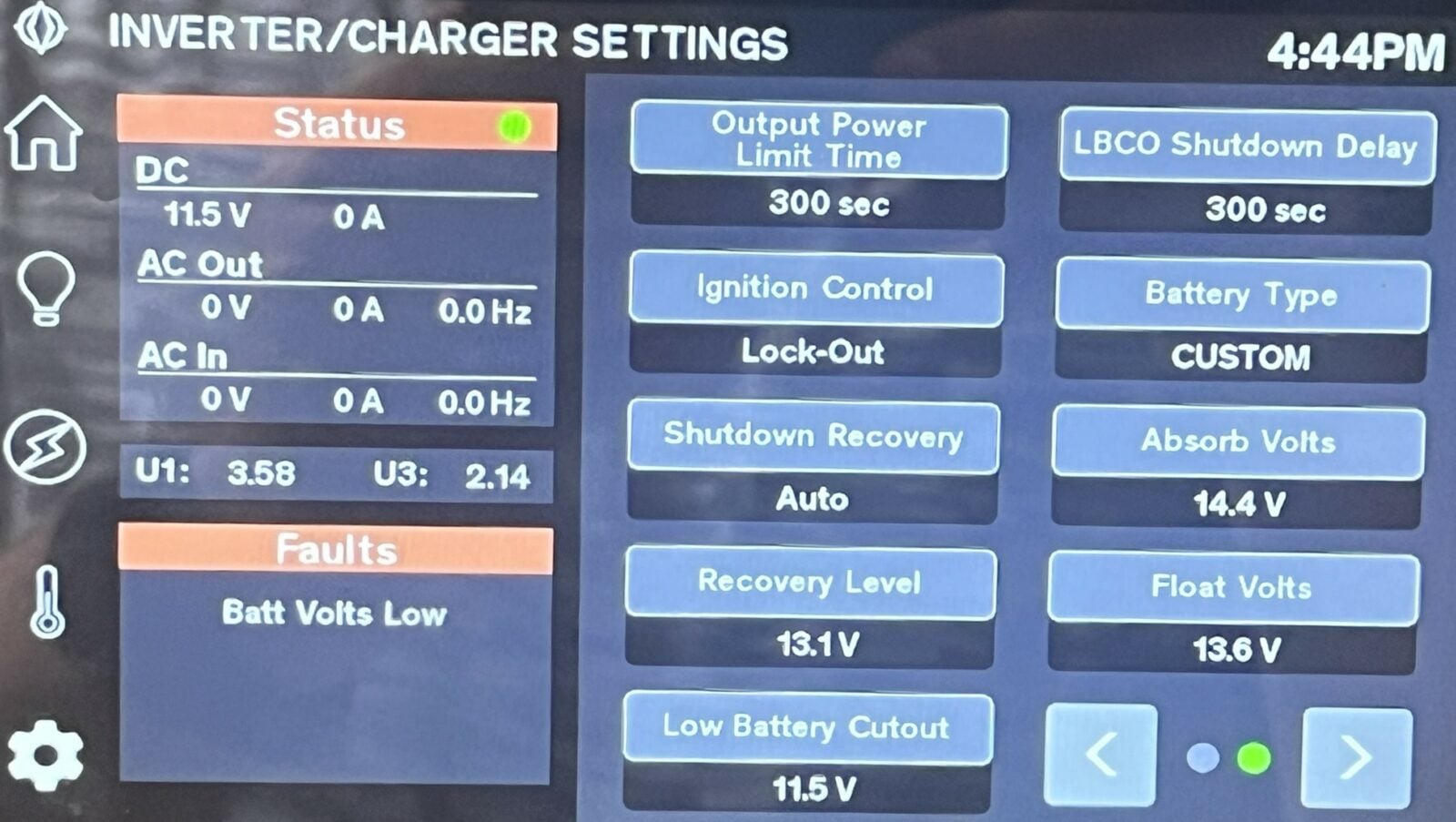
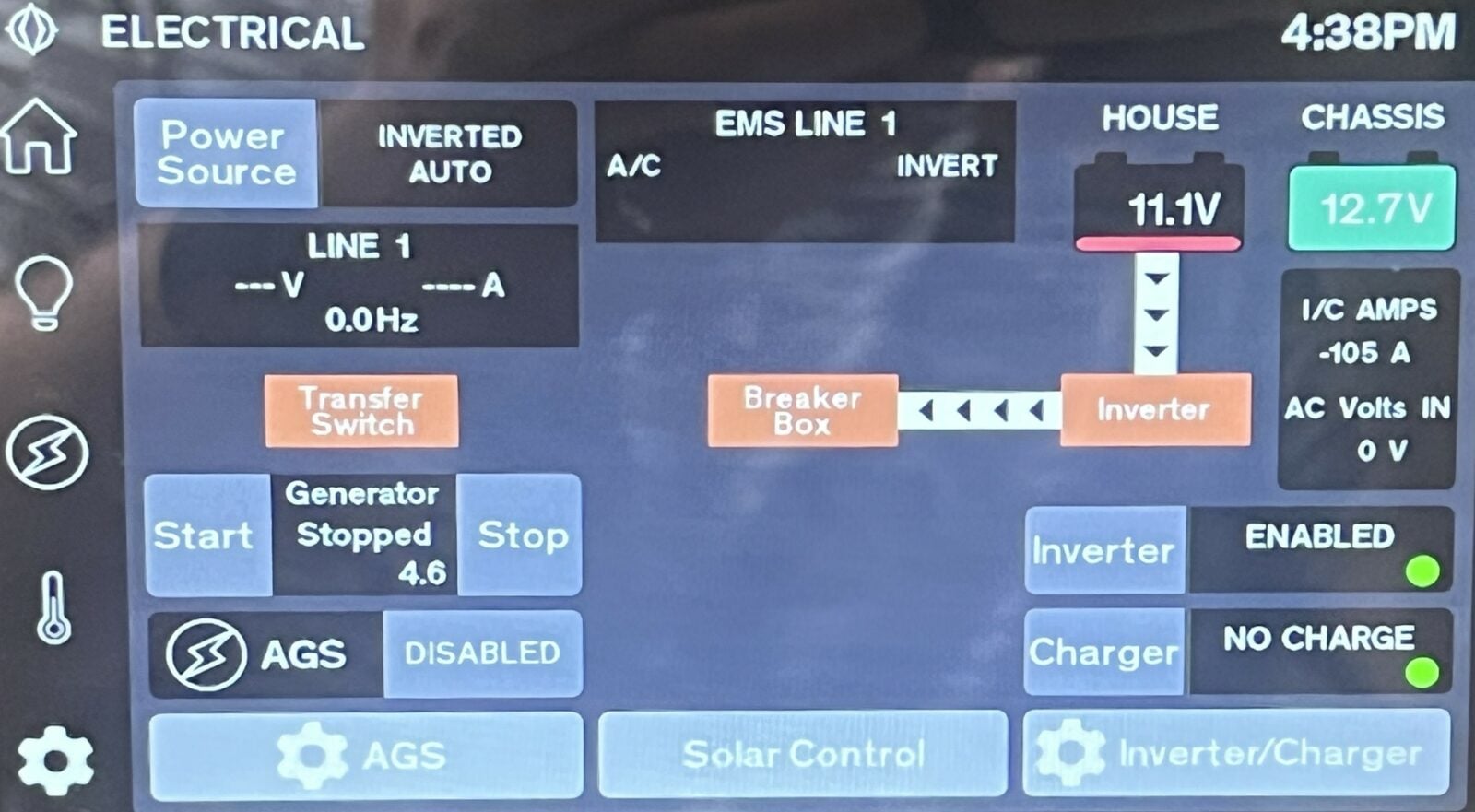
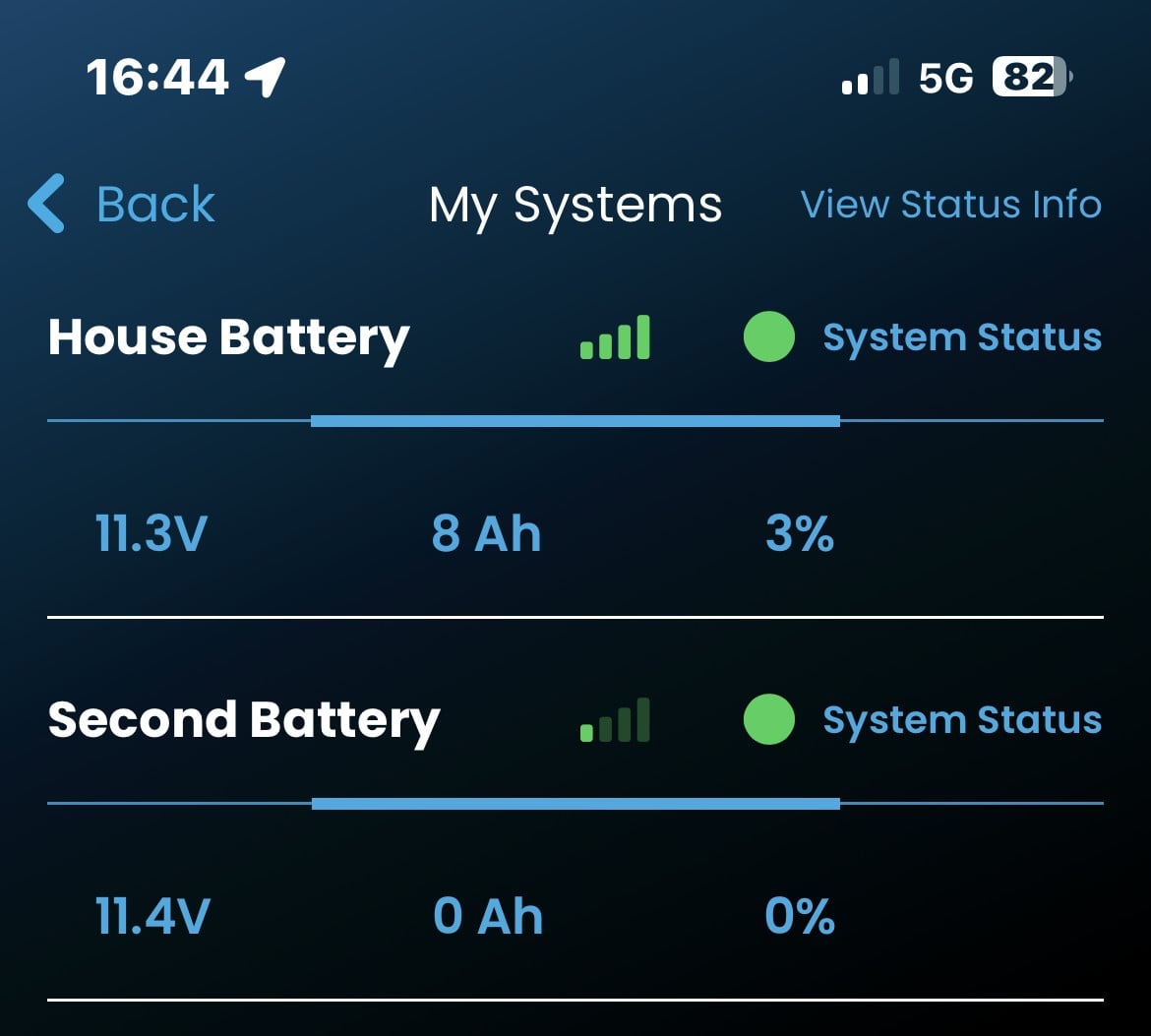
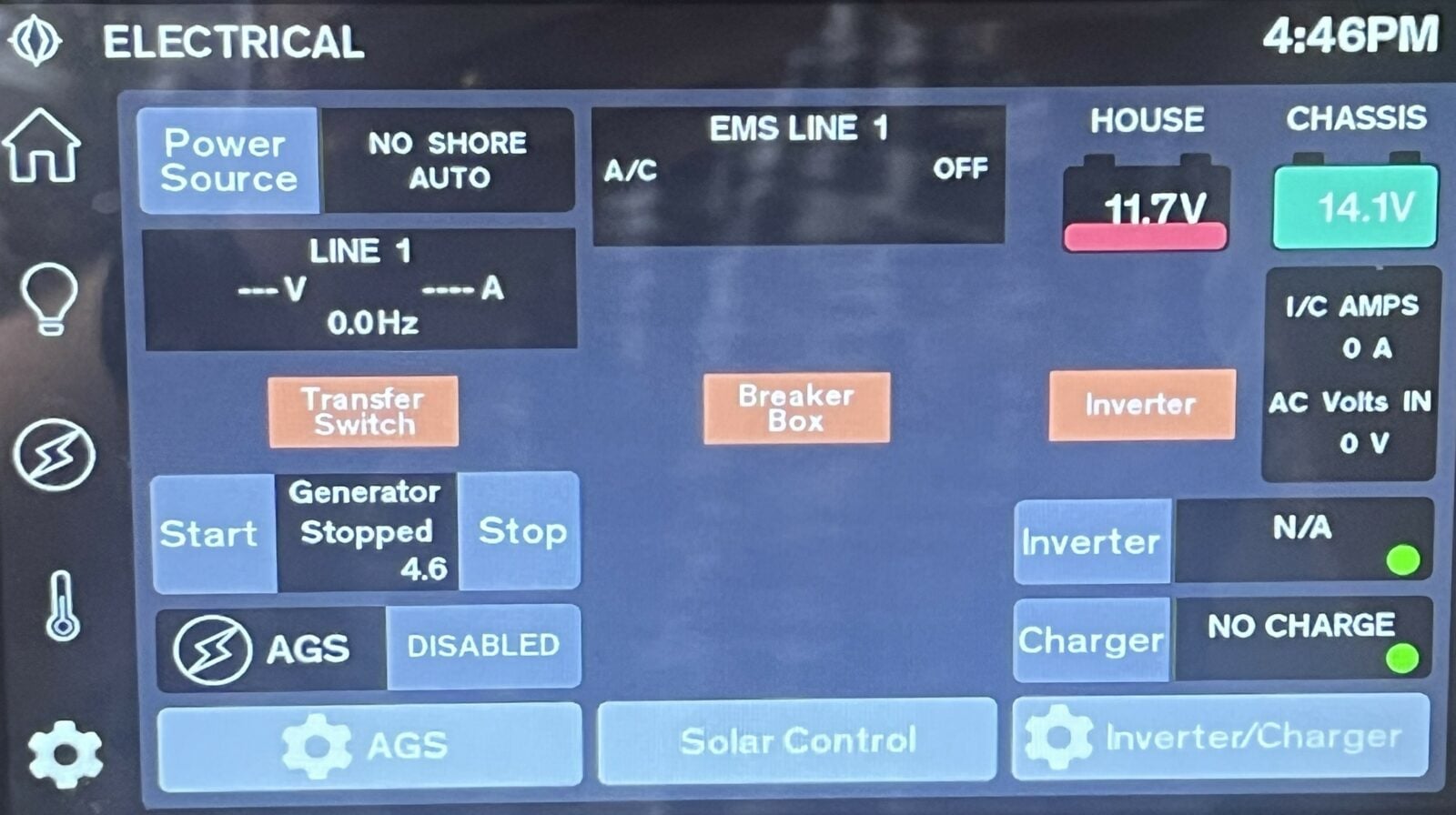
Some LTV owners might feel that depleting the house batteries this low is too risky and might use the Auto Generator Start (AGS), but I did not test this. I understand that, as long as I do not leave the batteries in a mostly-discharged state, there is no damage to them. This article from Battle Born suggests they are good for 3,000-5,000 discharge cycles. The chassis battery is isolated from the house battery, so I have confidence that I could start the engine and drive away with depleted house batteries, but it is for each owner to understand their risk tolerance.
How About Charging the Batteries?
I also wanted to understand how long it would take for the house batteries to charge. There are four potential charging systems: a 400-watt solar, 50 50-A in-vehicle (DC to DC) battery charger, a 4-kilowatt generator, and shore power. The solar and in-vehicle chargers can be used in combination with either the generator or shore power. The transfer switch allows the generator or shore power to power the coach.
| System | Amps to batteries | Comments |
| 400 W solar | Up to 25 A | I believe this is a practical maximum with this system. Less than 25 A will be typical. |
| In-Vehicle charger (DC to DC) | 50 A | Revving the engine made little difference. |
| Shore Power | Up to 150 A (limited by Inverter) | Depends on shore power breaker setting (15 A, 20 A, or 30 A). |
| Generator | Up to 150 A (limited by Inverter) | Depends on other loads on the generator. |
The maximum amount of charge possible is 25 A solar plus 50 A DC to DC plus 150 A shore power or generator, totaling 225 A. This would charge the 540 Ah batteries in 2.5 hours. Battle Born’s FAQs suggest a maximum charging rate of half the capacity, i.e., 270 A for a 540 Ah set of batteries. This Battle Born article explains how the battery’s state of charge controls the charging current. Charging current does not flow into a fully-charged battery.
However, the 150 A from shore power or generator might not be possible. First, if plugged into a 15 A (120 V) outlet with the Firefly configured accordingly, the inverter will limit the current draw to 12 A (120 V) as electric codes limit the continuous current to 80% of the rating. With other system losses and uses, this limits the charging current from a 15A (120 V) outlet to about 100 A (assuming no air conditioner). Second, if configured for 30 A (120 V) shore power or using the generator, the maximum incoming current is 24 A (120 V) per the 80% rule. However, if other systems are using this power, such as the air conditioner, the power available to charge the batteries will be reduced and the length of time required to charge them increased.
Summary
I have run my air conditioner through the night on batteries multiple occasions, with the temperature in the 80s, and with the thermostat on 70. Whether I can run my air conditioner on battery through the night depends on the following factors:
- The state of charge that my batteries start the night at. Ideally, they are at 100%. Less than that can still be sufficient, depending on the outdoor temperature.
- The house temperature relative to the thermostat. If the house has to cool down to the thermostat temperature, the air conditioner’s compressor will run continuously until the temperature is reached. This uses more power than when the house is already at the thermostat’s temperature.
- The temperature difference between the outside and the house. A greater temperature difference results in more heat flowing into the house and more air conditioning needed. Normally, the temperature drops through the night, so such a temperature difference (and the resulting energy use) drops.
- The above assumes the Wonder includes the optional extra 270 Ah battery.
The motorhome’s Battery Management Systems (BMS) protect the lithium batteries from damage. The house batteries have a Low Voltage Disconnect at 10 V, which requires a special procedure to wake up from. The inverter has a Low Voltage Cutout at 11.5 V, from which recovery is quick and easy using the generator or in-vehicle charge. Using Automatic Generator Start is a third option.
Running the batteries down to the inverter’s Low Voltage Cutout is a very valuable experience and gives confidence in using the system, understanding its behavior, and working around some quirks.
What About Other Upgrades?
LTV has chosen this configuration and options based on their understanding of the market, and finding a balance between cost, reliability, and fitness for purpose. For some owners, this functionality will be more than they want, and they are happy with the standard 270 Ah battery. Other owners want more and seek aftermarket upgrades. I aim to get the most out of the standard configuration with the second battery. While I accept that more cooling capacity would be nice to have, our goal is to take our Wonder where we don’t need air conditioning! This technology has advanced rapidly over the last few years and is likely to continue.
I look forward to what we will do with our Wonder during the next few years and how the technology will evolve.
Appendix – Some Quirks
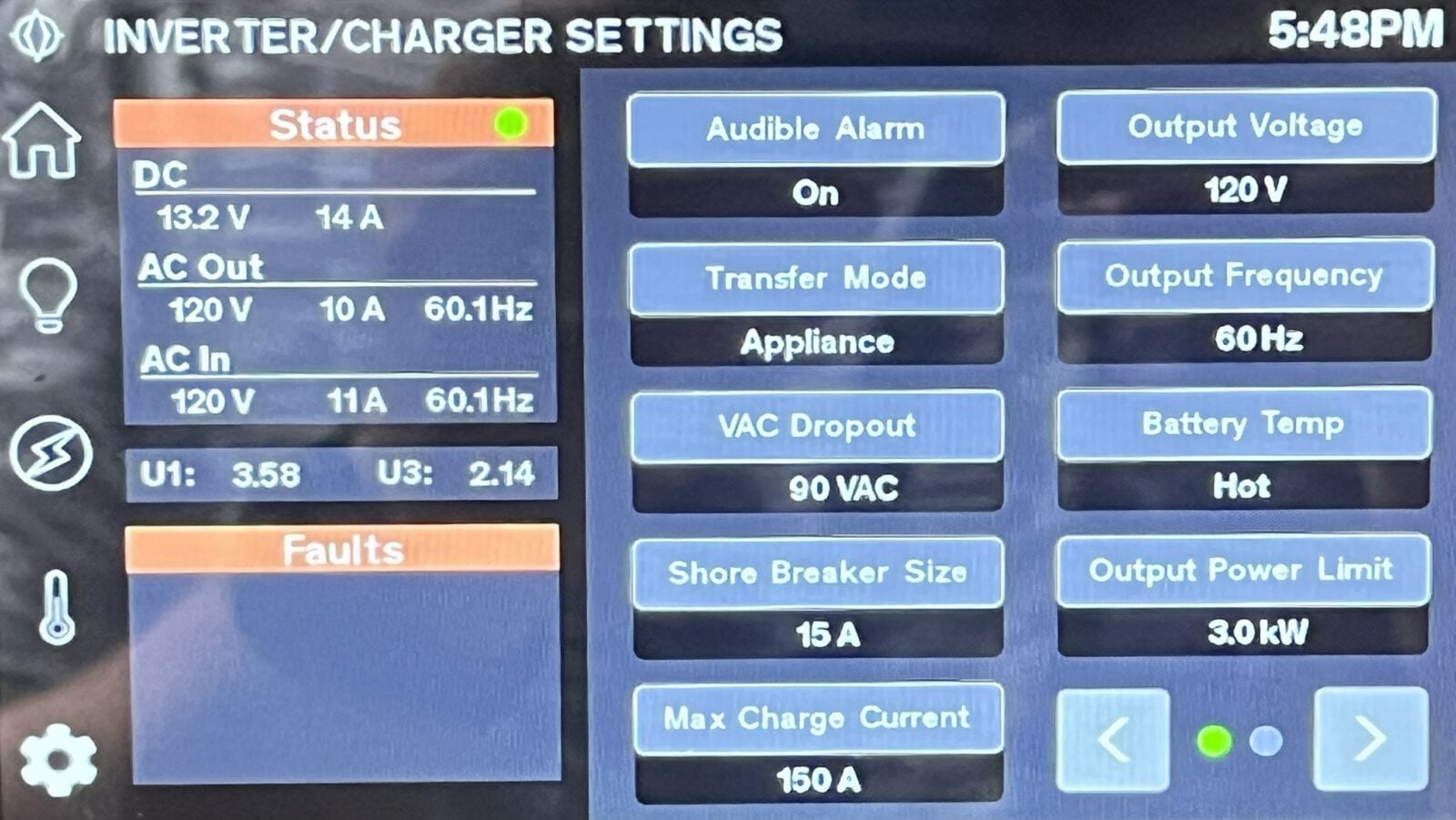
I want to share two quirks. First, when the inverter switches to the generator, the incoming current limit is retained based on the Shore Breaker Size setting. Therefore, the same limit applies to the generator if your last shore power connection was 15 A (120V) and the Firefly was set accordingly. This limits the incoming amps to 80% of the value, i.e., 12 A (120V). If charging the batteries, this limits the charge to about 100 A. However, if you are also trying to run the air conditioner, it significantly limits how many amps recharge the batteries. Darrell Heide at Triple E informed me that they are pushing the Firefly manufacturer to change this. Unfortunately, I have not found a way to change the Shore Breaker Size setting when you are not plugged into shore power, though I understand it’s possible by interacting directly with the Xantrex inverter.
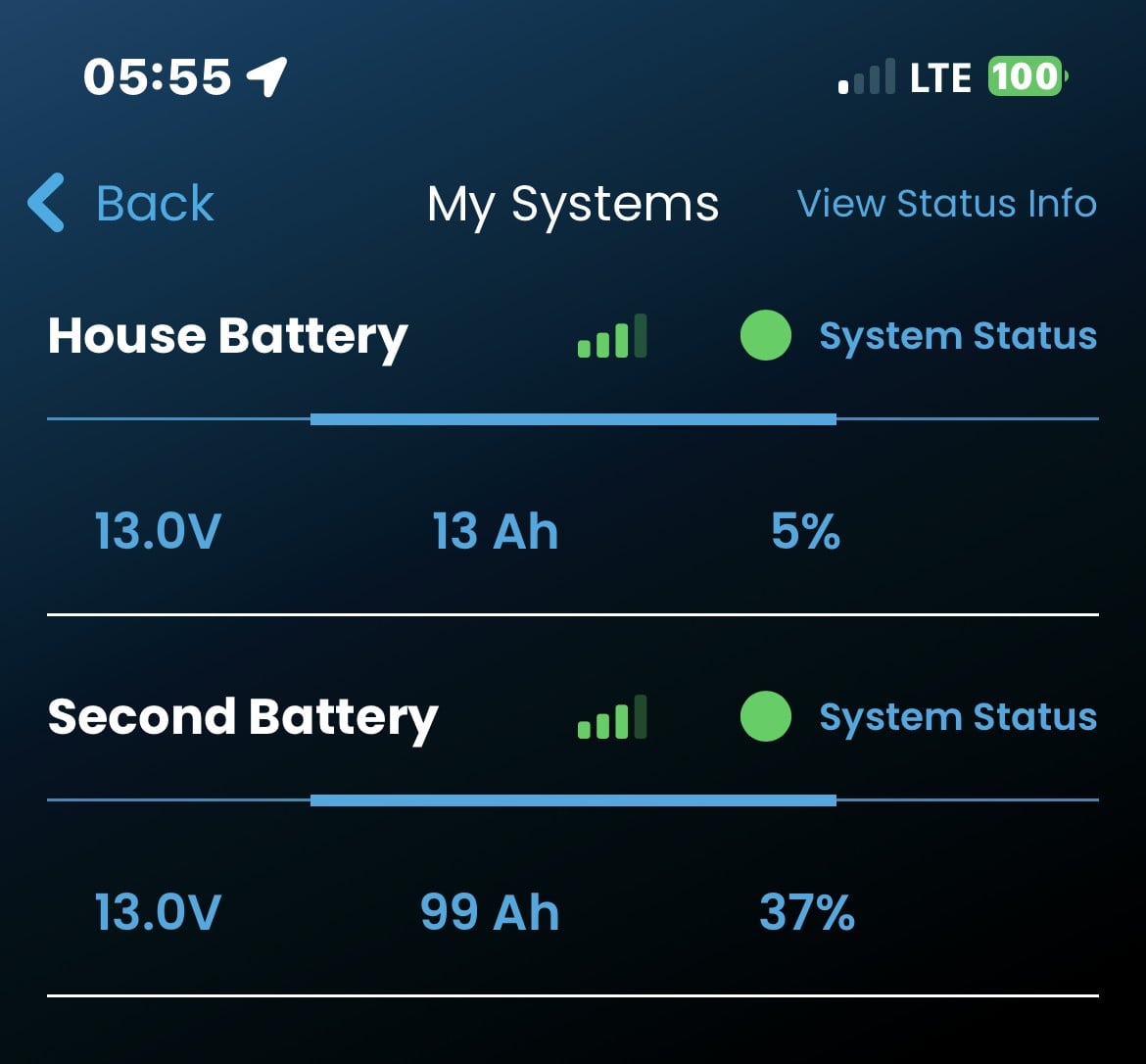
Second, the Battle Born app’s State of Charge might be incorrect. In an earlier discussion about the Battle Born app measurements, another LTV owner asked me how I knew that the measurements were correct. At that time, I had not considered this, and everything had looked fine. Since then, I have seen some behavior that I know is wrong.
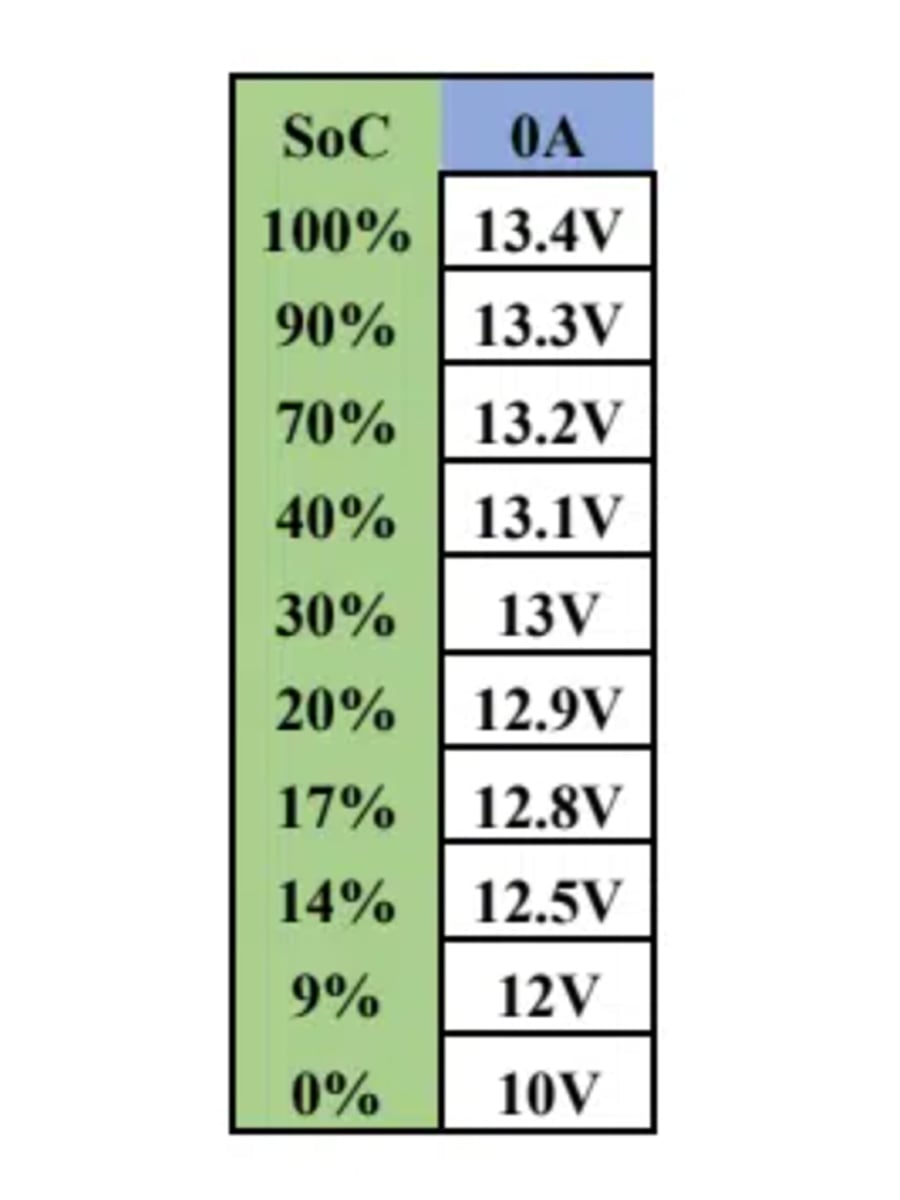
Several days into a trip, I noticed that one battery showed a significantly lower State of Charge than the other. Another LTV owner told me that Battle Born had recommended uninstalling and reinstalling the app to improve this behavior. This made me look closer at the State of Charge that the app was presenting. The app is attempting to measure the amps used over time to calculate the remaining capacity. Such measurements drift over time, resetting when the batteries are 100%. This can be verified by checking the battery’s no-load voltage with the battery’s State of Charge table. I find all of this somewhat imprecise, which I have to accept as part of the setup. It emphasizes the value of gaining experience rather than just relying on the numbers.
Thanks
I want to thank Darrel Heide at Triple E for explaining some things and confirming my understanding of others. I’d also like to thank various contributors to related discussions on the Leisure Travel Van Enthusiasts Facebook Group, especially Mike Meerschaert and Thomas Westhoff, who provided direct input. I have attempted to find a balance between simplicity and comprehensive description. Any remaining errors and inaccuracies in the text remain mine!
Feedback and Questions
If you have any experience to add to the above, please share below. In particular, have you “woken” Battle Born batteries up from a Low Voltage Disconnect, and how did that go? How much current does a CPAP consume? Have you come across any other quirks? Also, please share any questions you have, and I will attempt to answer!
Editor’s Note: The views, recommendations and opinions expressed in this article are those of the author(s) and are not necessarily those of Leisure Travel Vans.
This is a companion discussion topic for the original entry at https://leisurevans.com/blog/how-long-will-the-batteries-in-my-new-wonder-last/