I USED TO LOVE experimenting with a portable camp stove and a cast-iron skillet — and didn’t mind doing dishes in a collapsible wash basin. Now, I don’t know if I’ve matured (some might say I’ve gone soft), but I’m comfortable saying those days are mostly behind me. I relish the expanded cooking ability that comes with my RV kitchen. Tailgating, cooking outside, quick meals on the go, or meals that involve a lot of prep — my kitchen makes it all possible, but not all kitchens do.
After touring hundreds of RVs (and camping and cooking in many of my own), I have a good understanding of what actually makes an RV kitchen work for me. Features, appliances, layouts, design — I know what’s going to enhance the experience, whether I’m cooking for a big group or just myself. I put together this guide to share some takeaways about the best RV kitchens across different RV types, sizes, and budgets. If you’ve ever found yourself especially miserable or especially inspired while cooking in a particular RV kitchen, perhaps you’ll share some of these observations. But the real goal here is to help you improve your meal prep, organization, and creativity, so that cooking at the campground or before the big game carries some of the same joys as cooking at home, or maybe even unlocks some new ones.
How I Evaluate RV Kitchen Space
When I step into any RV, my eyes naturally go to the kitchen first. Counterspace alone tells me a lot. I’m mentally setting up a cutting board with onions, garlic, tomatoes, and a handful of other veggies, and then imagining where the prep bowls go as I stage everything. If I can picture that workflow fitting comfortably, my first box is checked.
Manufacturers are aware of this, too. From small Class Bs to larger family fifth wheels, expandable counters, added islands, and “coffee nooks” demonstrate a priority put on open counterspace. In RV reviews, you’ll hear that “prep space” term thrown around a lot, too. But quantity isn’t the only win. Can you comfortably find a place to lay everything out, set up a cutting board, and maneuver to your cooking surfaces? Even in a small kitchen, this makes a difference.
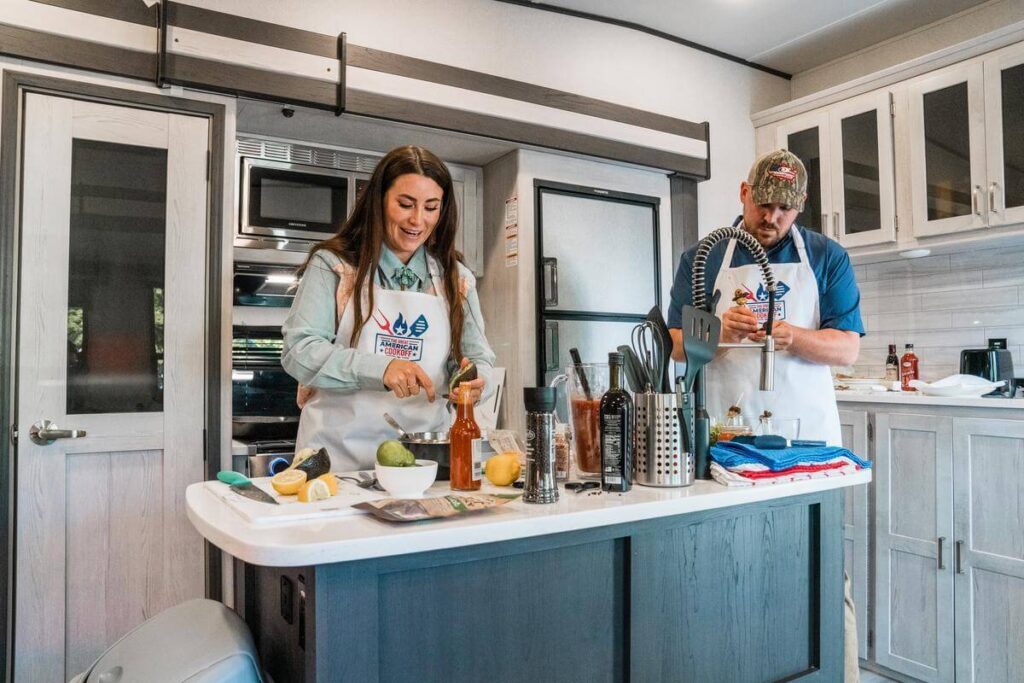
Next, the cooktop. I’m a three-burner minimum person. I want the freedom to sauté vegetables, sear meat, and simmer a sauce, all without turning the timing into a puzzle. I’ll always prefer to take the proteins outside when the weather cooperates, but when it’s raining sideways or too windy to keep a flame, those three burners are non-negotiable. But not everyone needs all this. Check out how Mike Bezemek includes other RV cooking methods and recipes that don’t always involve a stovetop.
As you’re evaluating an RV kitchen on a walkthrough, here’s my tip: stand over that cooktop and go through the motions of preparing a quick meal. The number of times I’ve seen a cabinet positioned low enough to catch you in the forehead the moment you get into a groove is alarming, not to mention all the other idiosyncrasies you may miss until you start cooking.
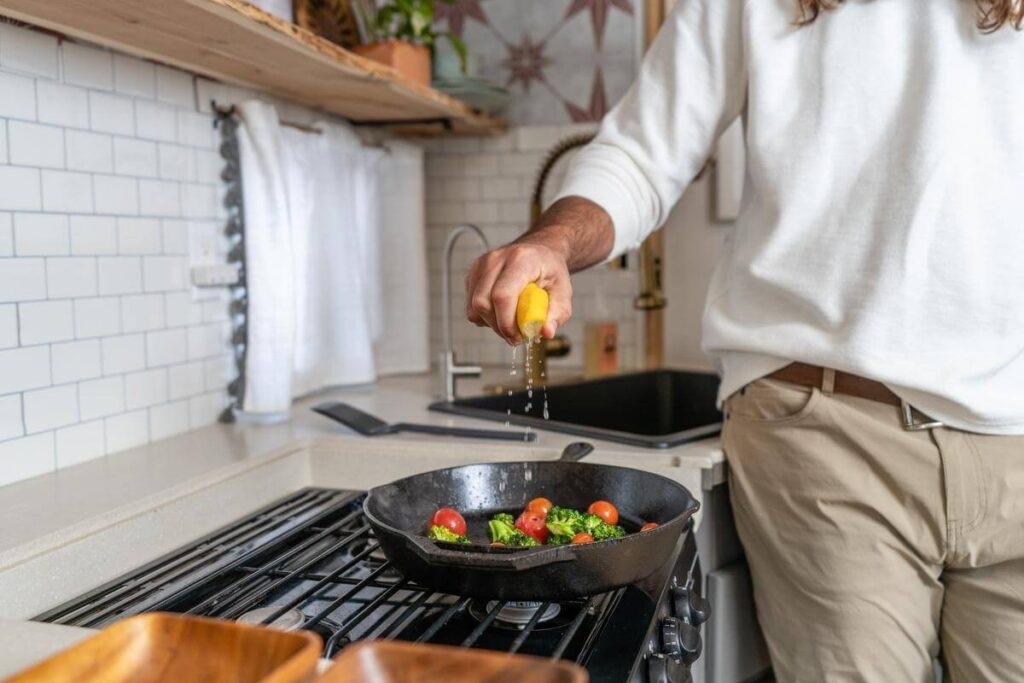
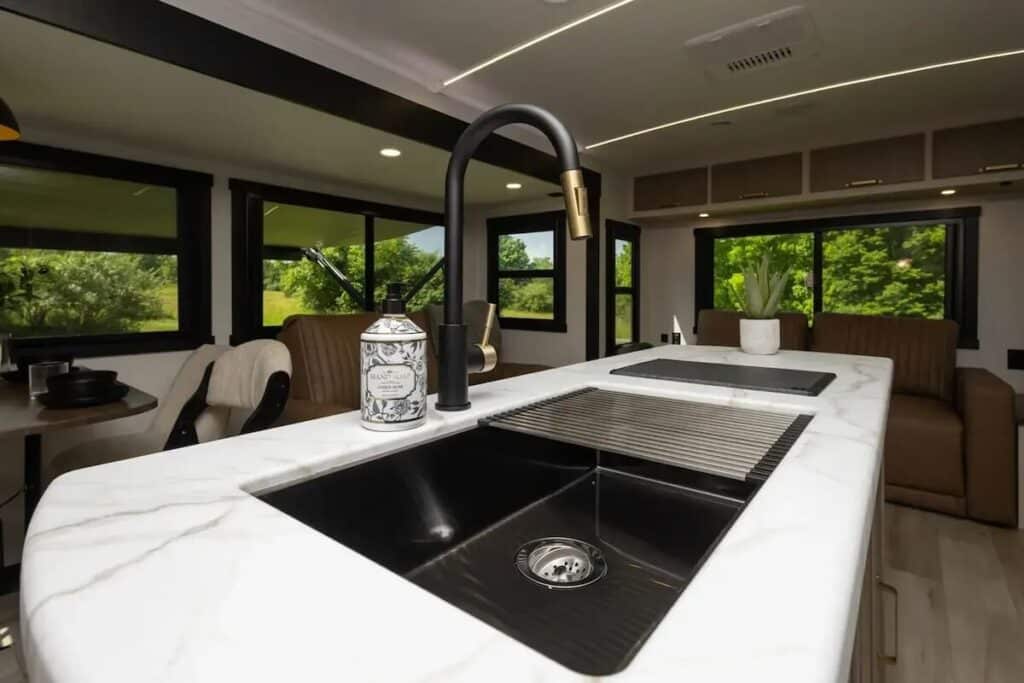
Next, the sink. After years of using dual-basin sinks, I’ve become a single-basin convert. The caveat is that the basin must be large enough to at least wash dishes in stages (i.e., all the dishes you used for eating first, followed by all the cooking implements).
What I think gets overlooked here is the counterspace-to-sink size ratio. I don’t have a strict recommendation, but I want enough room to have kitchenware in the sink, cooking utensils stacked on one side, and a drying rack on the other. Yes, the stovetop cover counts as usable space, especially in smaller RVs. And while I’m at the sink, check the overhead cabinet clearance. Bumping the same cabinet every time you’re washing dishes might sound small, but you’ll be thankful to avoid it.
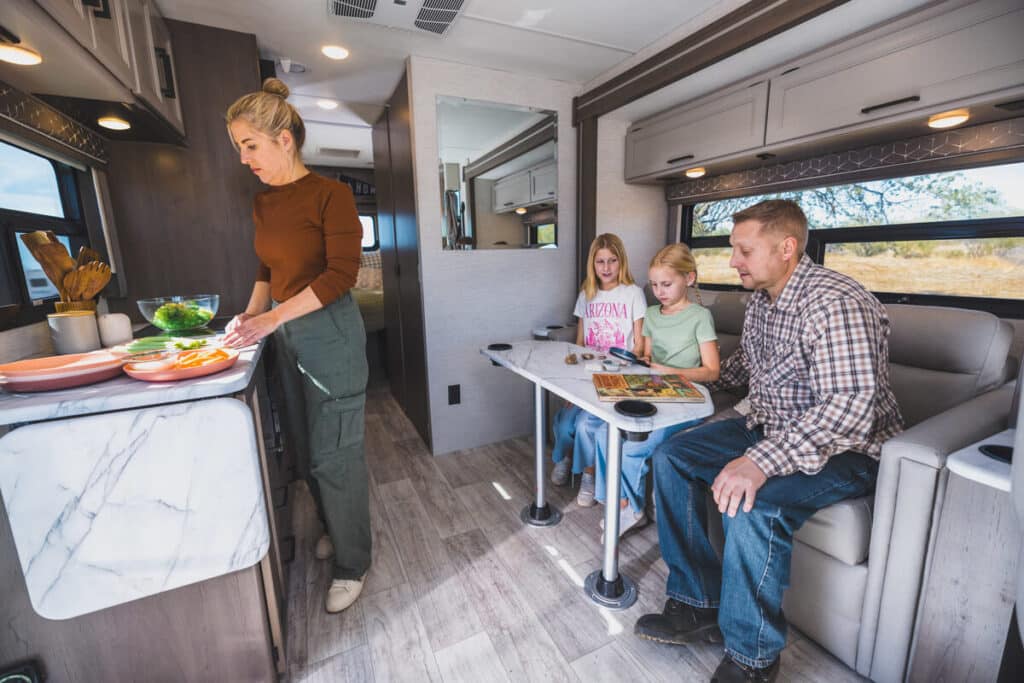
And how about the dinette? In many RVs, the dinette table is your real prep surface. The further it sits from your heat source, the harder your more involved recipes become. A tight, logical flow between those two spaces is my equivalent of cooking feng shui.
Last but not least, storage. Not just how much there is, but how it’s organized and where it sits. My trailer has an enormous cabinet under the sink, which initially looked great. But we quickly realized it was a wide-open cavern, essentially useless for kitchenware, until we stacked milk crates to create shelves for plates, bowls, mixing cups, and other essentials.
Will you be crouching down to pull plates from a low drawer before every single meal? Are your pantry supplies going to shift and bang around inside an oversized cabinet on travel days? What do you consider RV kitchen essentials, and do you have space for them?
The best RV kitchens aren’t about maximum storage, oversized appliances, or extensive counterspace. They strike a healthy balance that works for the way you want to cook.
But speaking of features, I’ve noticed a lot of “hype” out there.
Which Kitchen Features Actually Matter?
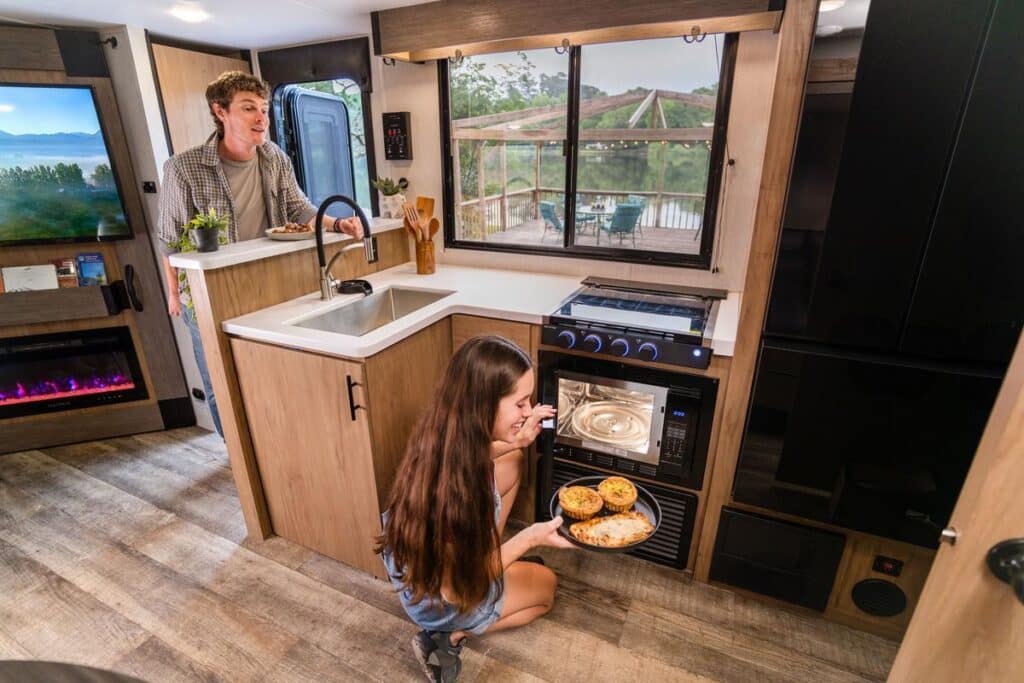
Each year, manufacturers roll out their latest kitchen features on new models. Some are worthy of the hype. Others aren’t, in my opinion. Here are some of the most common you’ll see; you can decide for yourself which are worth it.
The 3-in-1 Microwave, Air Fryer, and Convection Oven
The pitch sounds great: three appliances in one compact unit that meets the space constraints of RV living. But I’ve got the Furrion® 3-in-1, and I’ve tried the air fryer function for sweet potato fries, regular fries, buffalo cauliflower “wings”, and more — never with a result I’d call truly satisfying. So I shifted to the convection bake function, hoping for better results. Still not quite there. Now I basically use the microwave and try not to make eye contact with the cookie dough in the grocery store on RV grocery runs.
To be fair, it’s entirely possible I’m just a substandard operator. But if you’re a serious home baker, I’d recommend an actual propane-burning oven. And if you’re an air fryer devotee, a small countertop unit will likely serve you better than leaning on the combo function.
The Built-in Wine Rack Above the Fridge
You’ll find this on nicer fifth wheels, luxury travel trailers, and some destination trailers. It’s a feature that makes a lot more sense on destination RVs intended for extended stays than it does for life on the road. I genuinely can’t picture leaving bottles in an overhead rack while rolling down the highway, regardless of how good the suspension is.
If you’re parked for two weeks at a favorite campground, it’s a nice touch. But I’m skeptical it’s sealing many deals. It’s a good example of a feature that photographs beautifully and sounds enticing in a brochure, but likely gets used less than expected in real life.
The Flip-up Countertop Extension
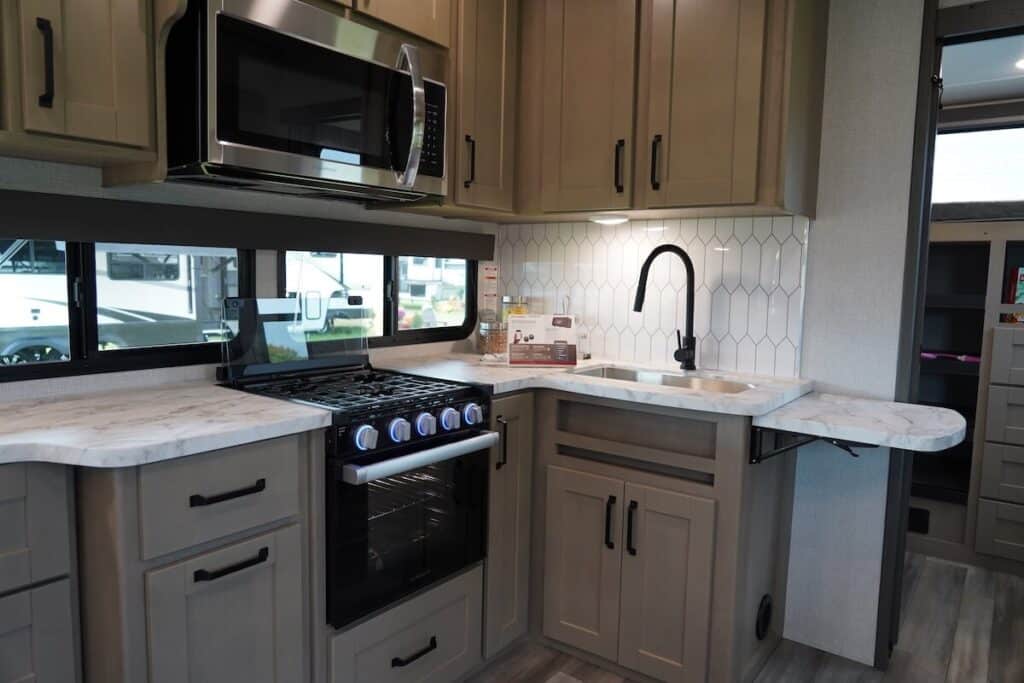
This is where I go the other direction. These extensions are genuinely useful, and honestly, I wish more manufacturers included them. They’re not meant to bear serious weight, and you definitely shouldn’t use them as a cutting surface if you want them to last. But as expanded prep and staging space, they make it possible to step up from simple meals to flexing your culinary creativity. The smaller the RV, the more this feature moves from “nice to have” to a near-must.
The “Oversized” Fridge
This one requires some context. “Oversized” is relative and varies significantly across RV classes. In the smallest campers, 3.3-cubic-foot mini fridges were once fairly standard. So when a manufacturer found space for an eight or 10-cubic-foot fridge, calling it oversized wasn’t unreasonable. But that baseline has shifted.
A 10-cubic-foot fridge in a sub-20-foot trailer isn’t uncommon anymore. What is uncommon — and where the “oversized” label actually earns its keep— is finding something like a 16-cubic-foot refrigerator in a budget-friendly travel trailer.
Keystone’s Coleman Lantern and Coleman Legacy are good examples. That’s the kind of cold storage that makes a real difference when you’re traveling with a family, especially if you’ve got teenagers who, as my Mom used to say, are “eating you out of house and home,” or if you’re ever cooking for big groups around tailgating season.
So, some of these are essential, some may be overhyped. But what kitchen features would I consider essential? For me, a big part comes down to floor plan.
Why We Chose A Front Kitchen RV
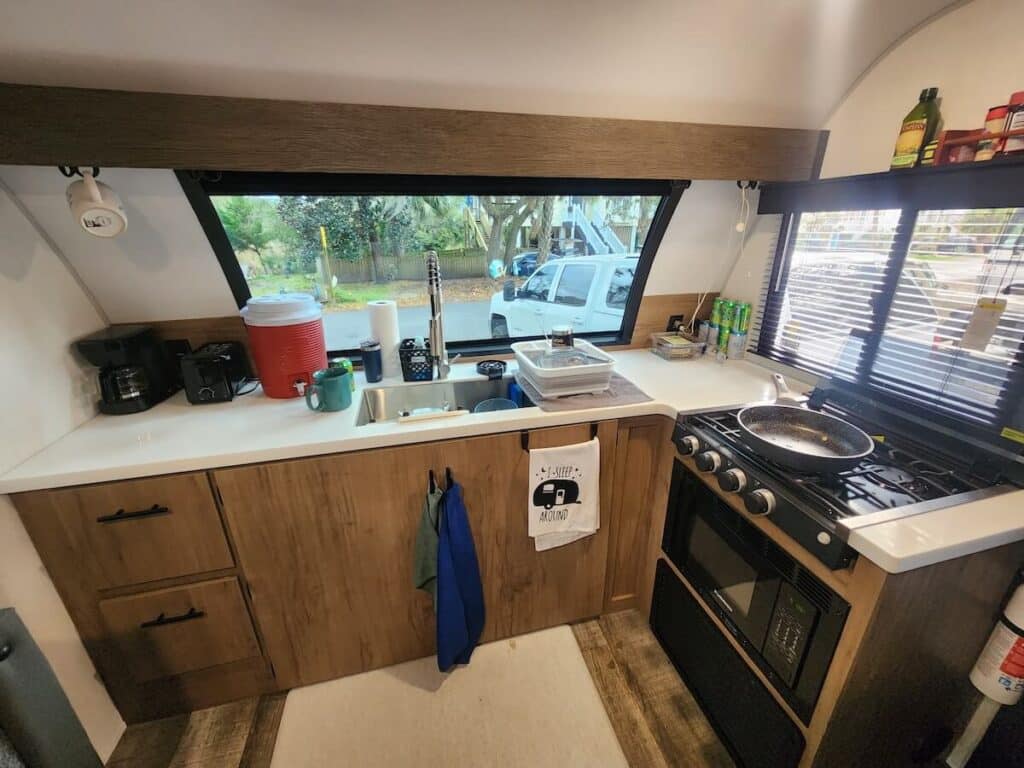
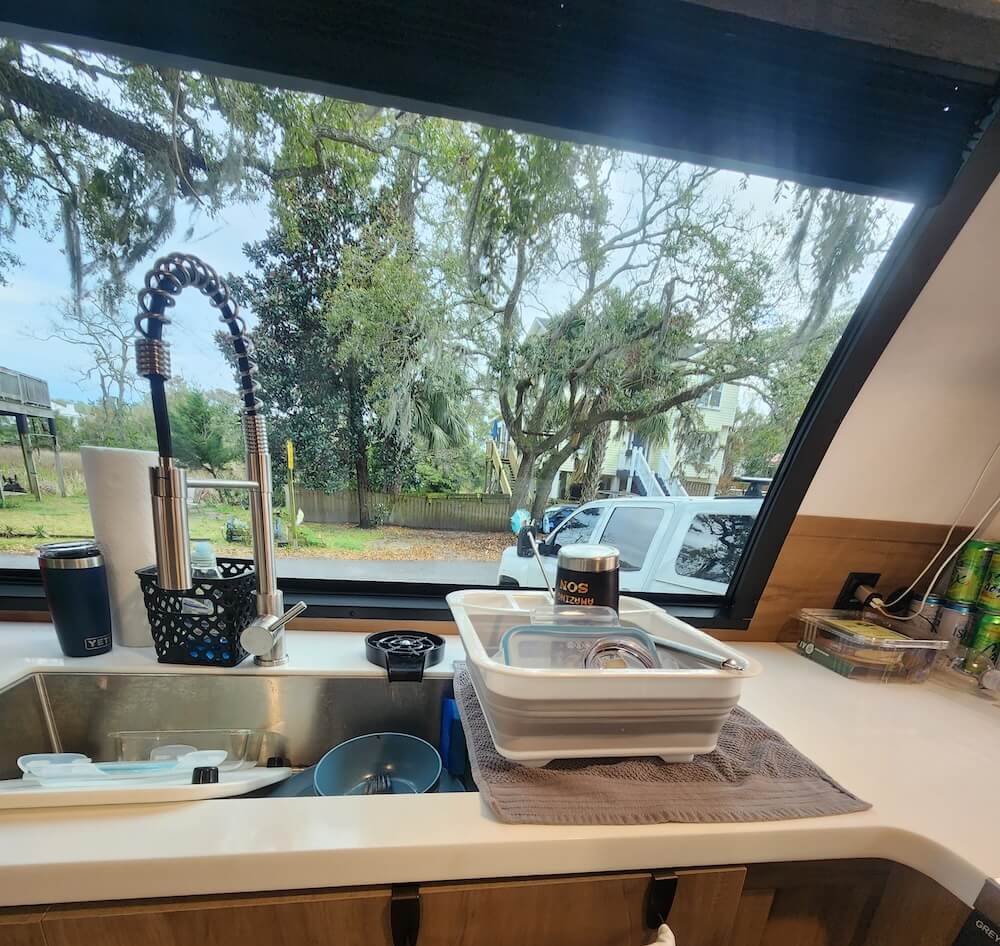
You likely already guessed, but the front kitchen was a major reason we chose our current trailer. Once we narrowed our search, it came down to the Campsite Ultra 26BW, the Campsite Ultra 26TH, and a Rockwood front kitchen model. Select factors beyond the kitchen (the 26BW’s dual entry and larger bedroom wardrobe) were part of the conversation. But a significant portion of our evaluation was a side-by-side kitchen comparison.
The Rockwood lost ground on the front window. The 26BW’s was noticeably larger, and once we started imagining the kitchen view — morning light, trees, whatever your site has going on — the smaller window felt like settling.
The windows in the rear kitchen of the 26TH were massive, too. But then we pondered what we’d actually be looking at: the utility side of a neighbor’s trailer, or, in most campsites, a fence out the back window? That realization quietly moved the 26TH down the list. Storage volume ultimately gave the 26BW another edge, earlier caveats aside. And then there was the outdoor kitchen. We use the mini fridge, a pull-out grill and griddle combo, and an LP quick connect even more than I would’ve expected, and it makes splitting the cooking duties between the indoor and outdoor spaces so easy.
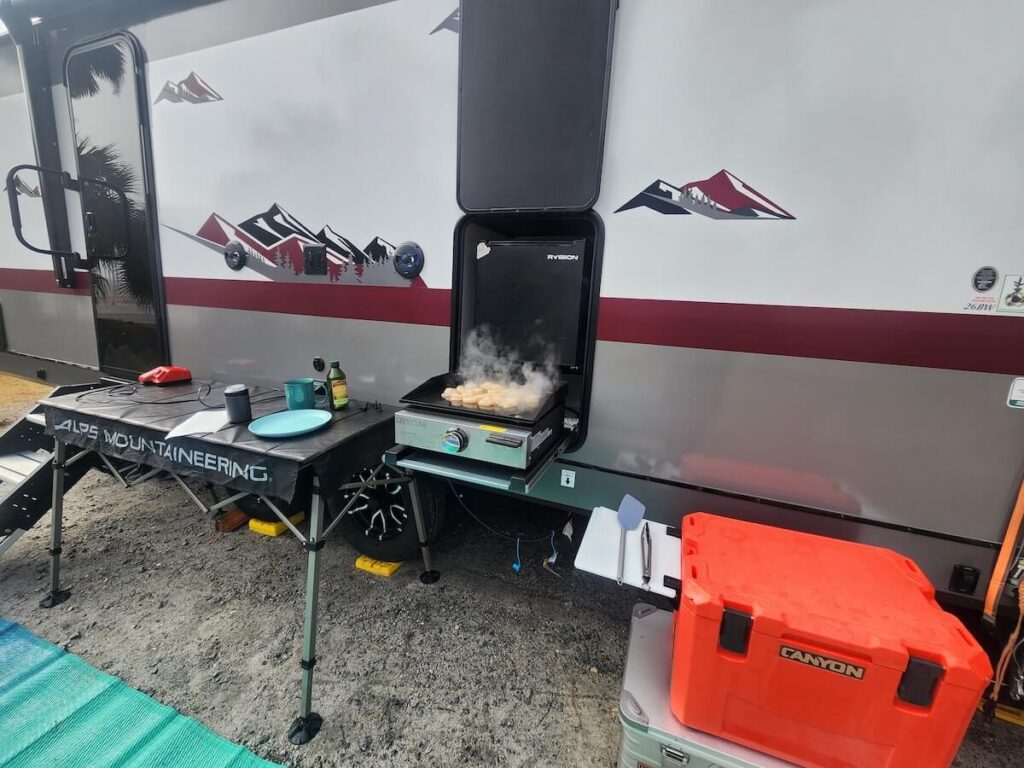
Images by Tucker Ballister
The right layout for you comes down to how you cook, who you’re feeding, and what you want to be looking at while you do it. Front kitchens push the cooking zone up front, usually with the biggest windows and the most counterspace, and keep the bedroom separated in the back, making them a favorite for couples and serious camp chefs. If that sounds like you, start with our roundup of the best front kitchen travel trailers.
Rear kitchens flip it, putting the kitchen at the back and tucking the bedroom up front for privacy, with the tradeoff being all that appliance weight riding over the rear axle. If a back-of-the-trailer cooking wall appeals to you, compare our picks for the top rear kitchen travel trailers.
And one last thing, since we’re being thorough here: that outdoor mini fridge has become our unofficial trip journal. Stickers from destinations we’ve visited have slowly taken over the door, and I catch myself pausing to look at them every time I’m out there cooking. It wasn’t a selling point, but it might be one of my favorite things about owning our setup. In fact, the outdoor kitchen may be a key decision point for you.
Why You May Need an Outdoor Kitchen
It doesn’t matter what type of RV camping you plan to do; the flexibility of indoor and outdoor cooking spaces is something I didn’t realize I was missing out on until I bought my current RV. Some of my favorite RV outdoor kitchen ideas showcase the personality of the RV owner, and it’s always surprising to see how they transform these spaces. If you’re reading this heading into fall, your outdoor kitchen is about to become the MVP of the parking lot. Here are some benefits of an RV with an outdoor kitchen:
Keeps your RV cooler and cleaner. Cooking inside an RV can significantly raise the interior temperature, and grease, smoke, and strong food smells have nowhere to go. This matters most with high-heat cooking like bacon, seafood, or anything fried.
Naturally keeps you outside. If you’re camping to enjoy nature, why head inside just to cook? On busy remote work days, mealtime is my built-in reason to step outside and reset.
Becomes a social hub. Your outdoor kitchen becomes where everyone gathers, chats, and enjoys each other’s company.
Expands your cooking options. More complex grill, griddle, and even smoking recipes become easy and enjoyable. Models with a propane quick connect rather than a built-in grill give you the flexibility to use your preferred option without being locked into whatever came with the camper.
Simplifies large-group cooking and hosting. You’ll enjoy convenient, extra cooking space next to the campfire. An outdoor fridge is a game-changer — stock it with drinks and condiments so guests can help themselves without stepping inside.
Your outdoor kitchen is a tailgating machine. A propane quick connect, and a pull-out grill-griddle combo turn a campsite setup into a full tailgate spread — burgers and dogs for a crowd, everything cooking outside while the game’s on, and a mini fridge keeping drinks cold so nobody’s tracking in and out of the RV.
If you’re building out a tailgate kit, check out our gear guide for RV tailgating. And if you’re still in the grill-versus-griddle debate, take a look at the best portable grills for RVers.
So yes, outdoor kitchens can transform your camping and cooking experience. The kicker is that ‘Outdoor Kitchen’ on an RV floor plan can mean many things, so be sure to check out the video above to understand what to look for. Then explore travel trailers with an outdoor kitchen.
Comparing Kitchen Floor Plans
Let’s look at a few examples. One of my favorite new rear kitchen layouts is the Mesquite 3850HBRK.
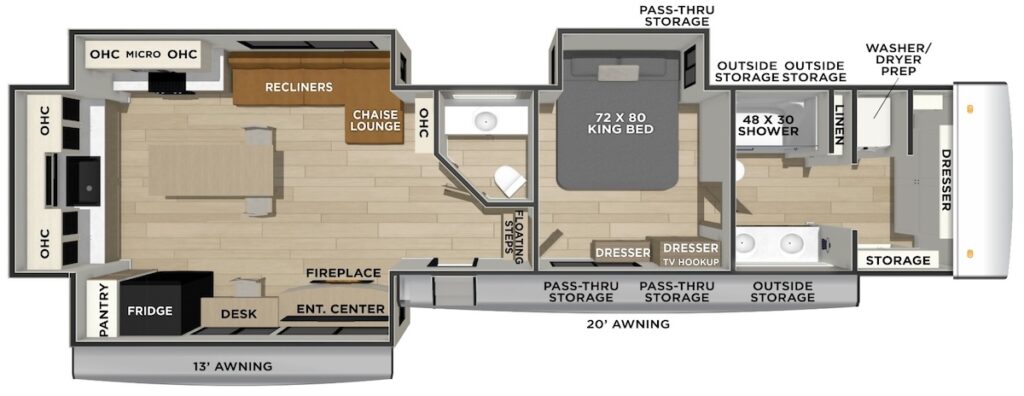
Placing the kitchen at the rear means you can use the entire back wall and a lot of that off-camp wall for counterspace on either side of the single-basin sink (yes, please) and cooktop, but then you add a central island and a “work desk” that serves as extra prep space. The flow from fridge to sink to cooktop to island easily gives two people the space to cook and enjoy meals together. An actual oven and oversized microwave exceed my expectations. While this floor plan lacks a true dinette, the bartop seating at the island makes up for it, and by extending the cabinets all the way to the ceiling, it feels like they’re daring me to add all the cooking appliances.
For comparison, I also loved the Cougar 25FKD when we were touring travel trailers.
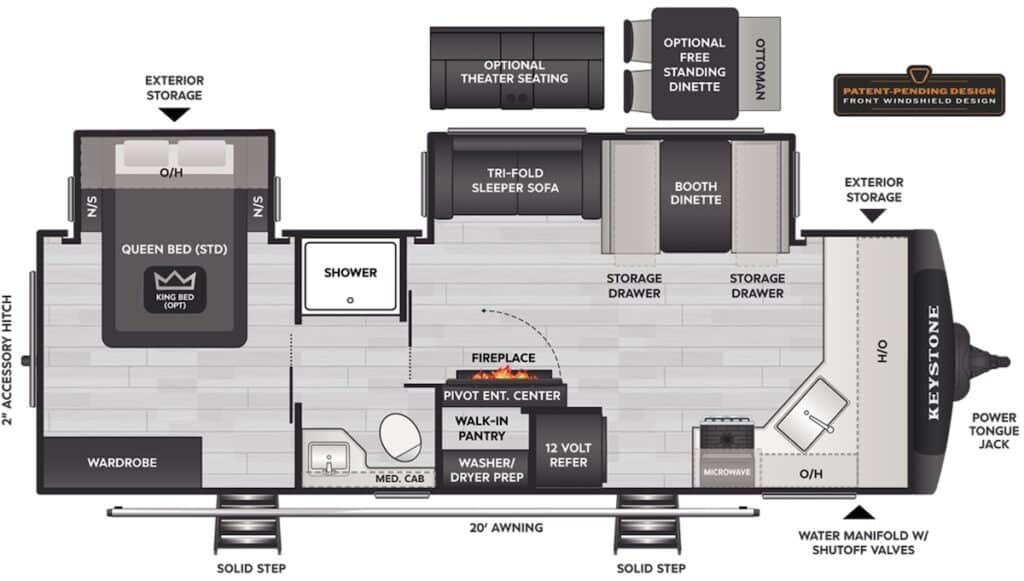
The layout is very similar to my trailer, with a few key differences. The L-shaped front kitchen still provides counterspace that few travel trailers in this class can rival. The appliance package hits those three-burner cooktop and single-basin sink musts on my list, and it also includes a microwave over the cooktop (where it should be!). Whether you opt for the booth or freestanding dinette, the placement makes it easy to move from the cooktop to counter to table with optimal flow. And one thing I wish my trailer had is all that overhead storage, in addition to the lower drawers and cabinets.
The great thing about front and rear kitchen layouts is that they minimize traffic through the kitchen. Everyone can get to the other areas of the RV without interrupting the chef. But mid-kitchen setups have their benefits too.
A popular mid-kitchen layout in the last few years can be found in the Campsite Elite 36AK.
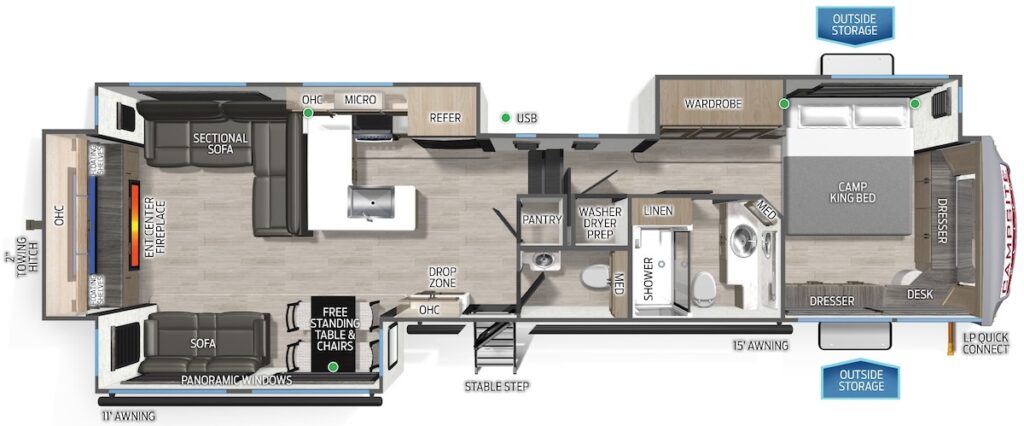
Placing the kitchen centrally creates space for a large rear living area. It also places your cooking zone closer to the central door for handing out supplies when you’re dining outside. This setup might lack the counterspace of the two previous models, but it still places the dinette close enough to have one person prepping there while the other cooks. The sink and cooktop offer the size you need to handle meals in a rig this big, and there’s plenty of storage thanks to the full-height pantry closet. By moving the kitchen to the off-camp side, Campsite also made room for a dedicated “drop zone” just inside the entry door, making that the go-to spot for keys and other small items instead of the kitchen counters.
Three layouts with their own distinct flow and function.
Which would you prefer? Let us know in the comments.
Own Your Kitchen, Own Your Search
My camp cooking days have evolved, and my standards for an RV kitchen have evolved with them. The point isn’t that my way is the right way. It’s that I figured out what I needed, prioritized it in my search, and owned the outcome.
That’s the advice I’d pass along to any prospective buyer: don’t let the kitchen and cooking setup be an afterthought. If you aren’t willing to settle for substandard camp meals, your kitchen evaluation has to be a pillar of your search.
Sort through the hype on your own terms. My takes on the 3-in-1 or the wine rack are just my takes. Your cooking style, your travel habits, and your family’s needs will lead you somewhere different.
What won’t change is that almost every RV kitchen requires some degree of customization. If you find a layout that checks 90% of your boxes, that’s a win. The last 10% is usually something you figure out with a little creativity once you’re out there cooking.
What are your must-have RV kitchen features? Let us know in the comments below!
The post Complete Guide to RV Kitchens appeared first on Camping World Blog.
This is a companion discussion topic for the original entry at https://blog.campingworld.com/find-your-rv/guide-to-rv-kitchens/