RECREATIONAL VEHICLES come in all shapes and sizes, and micro campers are at the smallest end of the spectrum. Low maintenance and often towable with an SUV, small truck, or minivan, micro campers have many advantages over their larger counterparts. While they may not fit everyone’s needs, micro campers are ideal for those looking for an affordable, simple, and easy-to-tow RV—the easiest of the bunch, we might argue.
We’re looking at some of the best micro camping trailers in 2026. Learn what’s available and how to choose the best micro camper for you.
Key Takeaways
- Micro campers are compact, lightweight RVs prioritizing mobility, affordability, and essential camping features. They are easily towable by SUVs, small trucks, and even some sedans.
- Top micro campers in 2026 include the Coleman 13B, Rockwood Geo Pro 15TB, Drifter 10ROK, Transcend One 131DL, and Catalina Summit Series 7 134BHX.
- Micro campers are low-maintenance, fuel-efficient, easy to store, and ideal for outdoor-focused travelers. They suit solo adventurers, couples, and minimalist campers who prioritize flexibility, affordability, and ease of towing.
What Is A Micro Camper?
Quick Answer: A micro camper is a lightweight travel trailer — typically 10 to 16 feet long and under 3,500 pounds — that can be towed by most SUVs and light trucks without a special tow package. They sleep 1–4 people and include a bed, basic kitchen, and sometimes a bathroom, at a lower cost than full-size travel trailers.
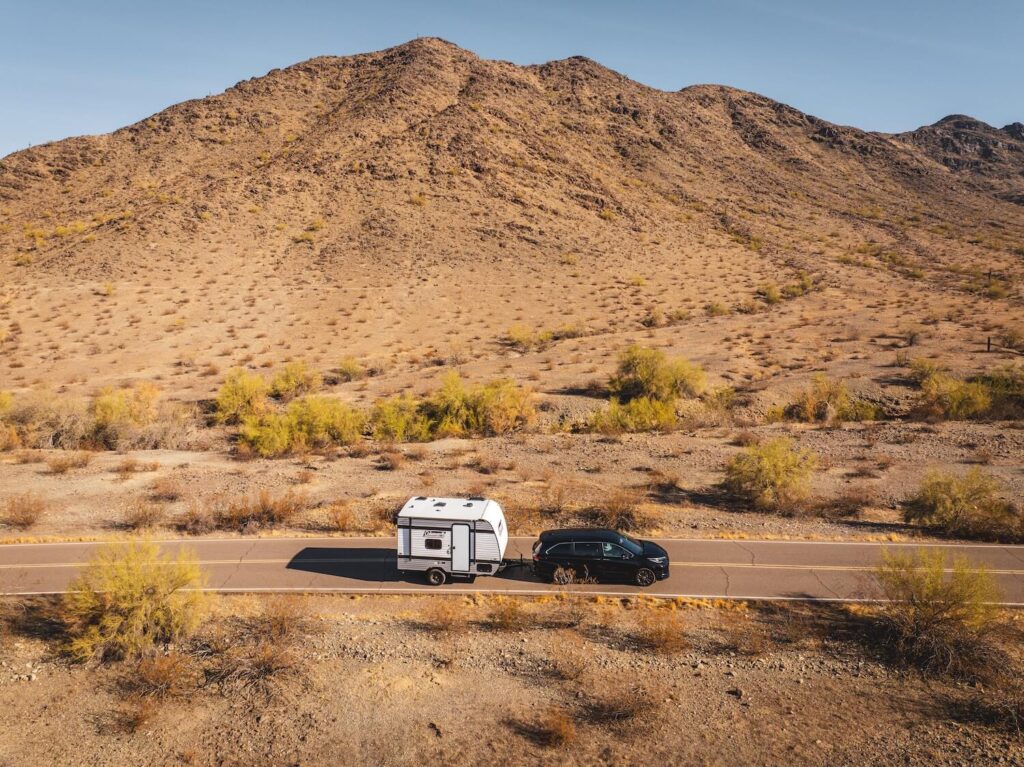
Micro campers occupy a distinct category in the RV market — smaller and simpler than traditional travel trailers, but a significant step up from tent camping. Where a conventional travel trailer averages 20 to 30 feet and 5,000 to 8,000 pounds, a micro camper cuts that footprint roughly in half. That difference in scale is what makes them maneuverable in tight campsite loops, storable in a residential driveway (or some even in a garage!), and accessible to the kinds of vehicles most people already own.
Despite their compact nature, micro campers feature camping essentials that make them an upgrade from tent camping, such as an actual mattress, a basic cooking setup, and sometimes even a small bathroom.
Most micro trailers comfortably sleep at least two adults, but some offer bunks or convertible dinettes for expanded sleeping capacity. Their design prioritizes ease of use, affordability, and the ability to go places larger campers cannot, making them popular for weekend warriors, minimalists, and those interested in off-grid camping.
Looking for larger SUV Campers?
What Is the Best Micro Camper?
Without further delay, let’s explore our picks for the best micro campers in 2026.
Keystone Coleman 13B
Specs
- Length: 15’11”
- Hitch Weight: 352 pounds
- Dry Weight: 2,506 pounds
- Cargo Capacity: 994 pounds
- Sleeps: Up to 4
The Keystone Coleman 13B is a standout choice for families venturing into the world of micro campers under 5000 lbs. It offers slightly larger dimensions and enhanced capabilities compared to typical micro campers. While it is heavier, the additional weight is justified by the ample space and amenities designed to accommodate family needs.
This Coleman camper is distinguished as an all-electric RV, offering a modern approach to camping that eliminates reliance on propane systems, enhancing both convenience and safety.
Inside, the Coleman 13B maximizes comfort with a 78″ interior height that opens up the space, making it feel less cramped—a significant advantage when camping with family. The electric fireplace adds a cozy touch, perfect for cooler evenings, while blackout night shades ensure a good night’s sleep by blocking out unwanted light.
Also consider the Coleman 13R (rear kitchen, queen bed), 13T (twin bed layout), and 13S (sofa bed)—all share the same compact platform and 78″ interior height as the 13B.
Bontrager Outdoors Drifter 10ROK
Specs
- Length: 13’2”
- Hitch Weight: 140 pounds
- Dry Weight: 1,700 pounds
- Cargo Capacity: 1,440 pounds
- Sleeps: Up to 2
If you’re looking for the lightest, most adventure-ready micro camper in this lineup, the Bontrager Outdoors Drifter 10ROK is worth your attention. Built for boondockers and off-grid campers, this featherweight, laminate teardrop trailer packs a surprising amount of capability.
Oversized all-terrain radial tires on alloy aluminum sport wheels, a torsion-flex 3,000-pound independent suspension axle with electric brakes, and an undermounted hidden spare tire make it one of the more off-road-ready options in this class. An exterior rear kitchen with a sliding griddle and 12-volt refrigerator keeps your camp meals simple and satisfying. A 13,500 BTU wall-mounted A/C handles warm nights, while the Truma® Combi furnace and water heater keeps you comfortable in cooler conditions.
Roof rails and storage compartments take care of the gear you can’t leave behind. Inside, two mattresses and smart netted storage make the sleeping quarters comfortable for two adults. It’s a minimalist camper by design—built for people who want to spend more time on the trail than inside the rig.
Forest River Rockwood Geo-Pro 15TB
Images by Forest River
Specs
- Length: 15’8”
- Hitch Weight: pounds
- Dry Weight: 2,833 pounds
- Cargo Capacity: 1,074 pounds
- Sleeps: Up to 2
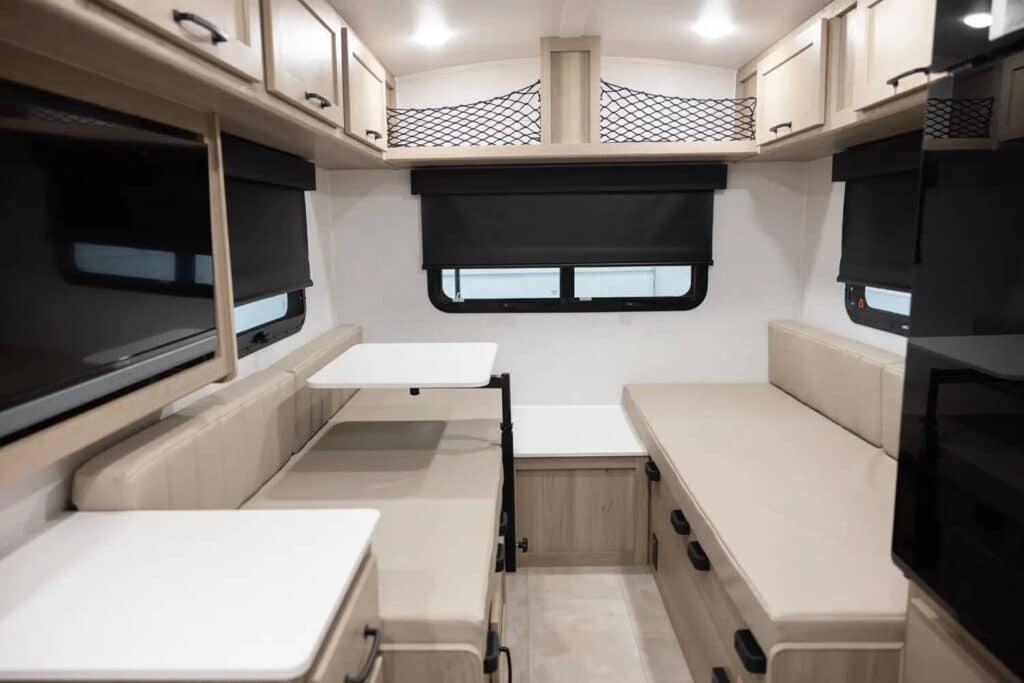
Ideal for the solo traveler or cuddly couple, the Rockwood Geo-Pro 15TB offers a unique floor plan with a twin bed conversion. This Forest River micro camping trailer features a dinette by day and twin beds or a single full-width sleeping area by night. The table top doubles as the king bed insert, making it easy to convert the space to your preference.
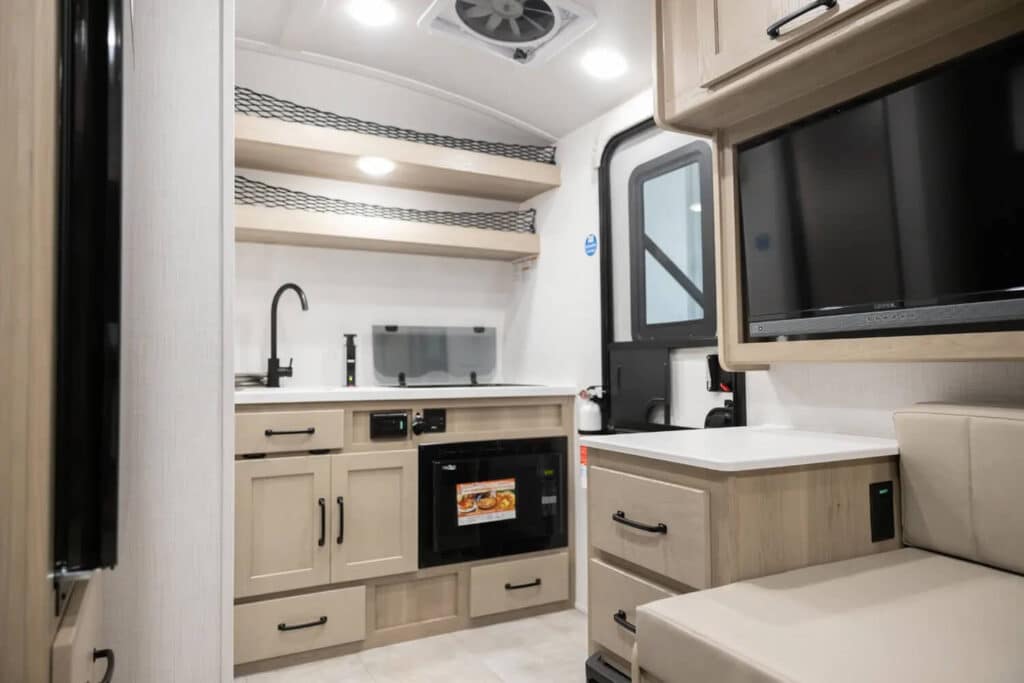
A 32” TV lets you enjoy movies and shows from that convertible dinette/bed space. The front of the layout houses the kitchen, which includes a stainless steel sink with a high-rise faucet, a microwave, a 12-volt refrigerator, and a recessed three-burner cooktop with a glass cover—a rarity in micro RVs.
On the exterior, a powered awning creates your ideal covered patio. Plus, Forest River made this one of the best micro camper RVs for outdoor cooking, as it comes with a gas griddle that attaches to an exterior rail and connects to the LP quick for grilling.
Identical floorplan, different brand: The Flagstaff E-Pro 15TB shares the exact same layout and specs as the Geo Pro 15TB but wears Flagstaff badging, which may affect regional dealer availability.
Grand Design Transcend One 131DL
Specs
- Length: 15’10”
- Hitch Weight: 364 pounds
- Dry Weight: 2,950 pounds
- Cargo Capacity: 1,470 pounds
- Sleeps: Up to 2
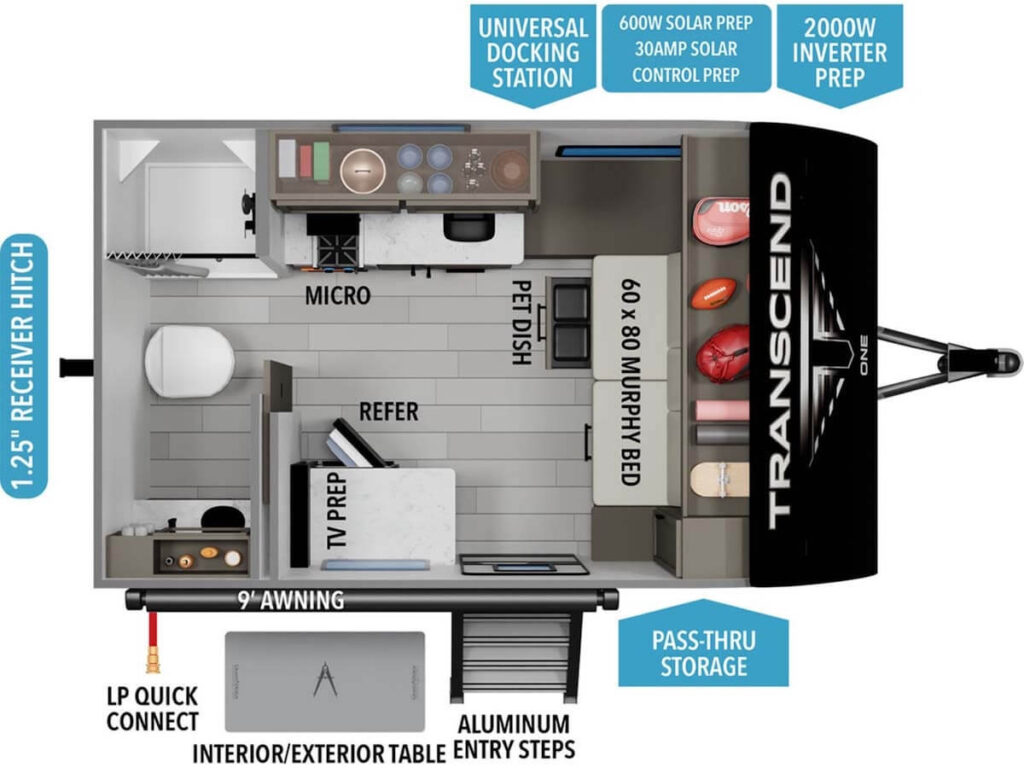
Grand Design built its reputation on quality-first construction, and the Transcend One 131DL brings that reputation down to micro camper size and price. While this camper is towable by any half-ton truck and most midsize SUVs, it doesn’t skimp on what’s inside. The 131DL features a 60″ x 80″ Murphy bed—a full-size sleeping surface that’s genuinely rare in this footprint—along with a walk-in shower, a tankless water heater, and a 3.3-cubic-foot 12V refrigerator.
The kitchen is practical and well-appointed: a 2-burner range with glass cover, a microwave, residential countertops, and dedicated cabinet storage. Entertainers will appreciate the JBL® sound system with interior and exterior speakers. It might also be the best micro camper for off-grid adventures, as it’s prepped for up to 600-watts of solar panels, a 2,000-watt inverter, and a 30-amp charge controller—meaning you can add batteries and panels and actually run appliances, not just charge a phone.
The Transcend One also includes built-in pet bowls, an exterior leash link, and shoe nook storage—small details that signal Grand Design is thinking about how owners will actually use it, not just how it looks on a spec sheet. The 131DL is new for 2026 and represents the best value in this feature set at its price point.
Coachmen Catalina Summit Series 7 134BHX
Images by Camping World
Specs
- Length: 16’
- Hitch Weight: 306 pounds
- Dry Weight: 2,647 pounds
- Cargo Capacity: 1,500 pounds
- Sleeps: Up to 4
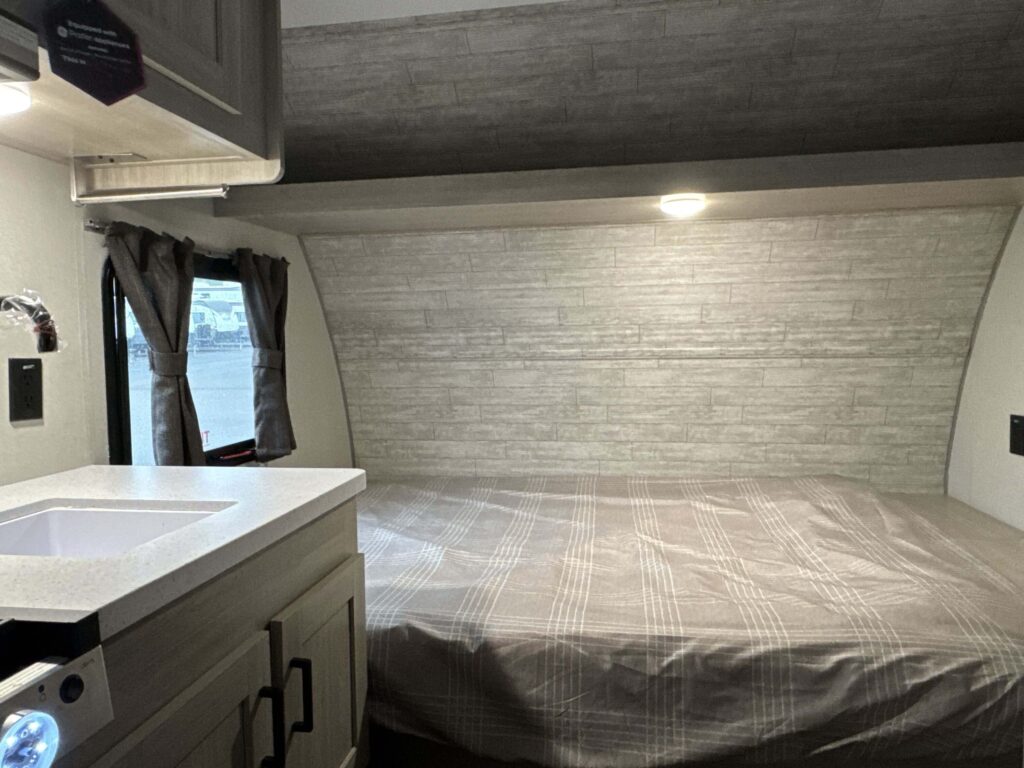
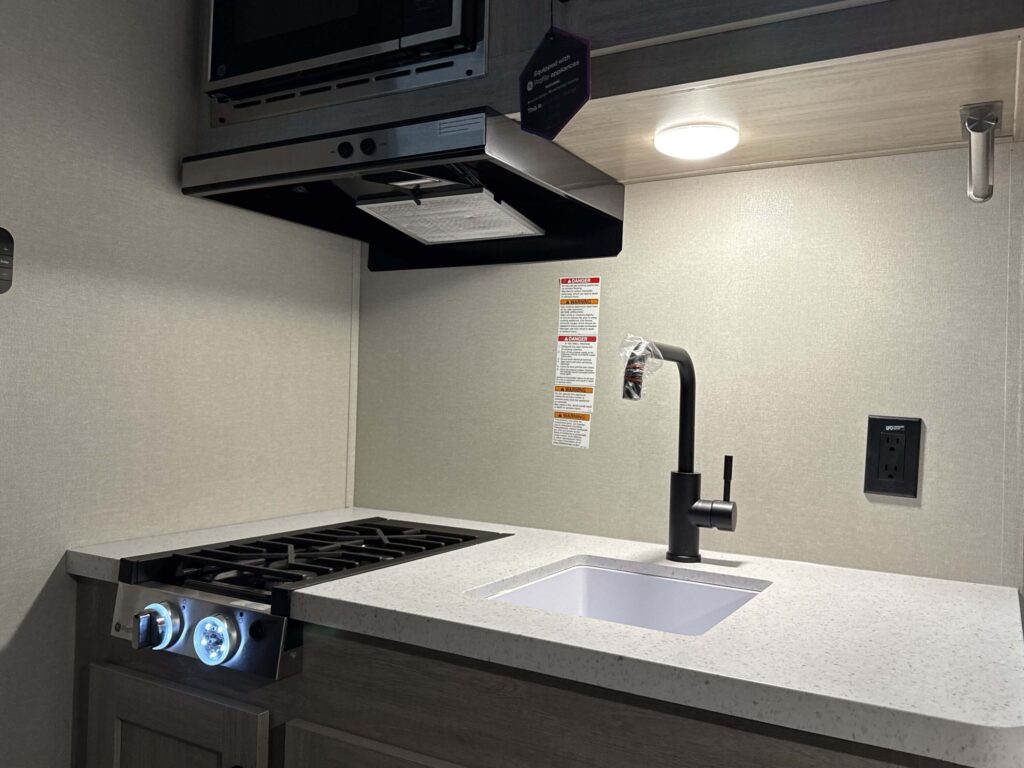
Coachmen’s Catalina Summit Series 7 was built with a specific goal: to deliver must-have features at a price point that doesn’t require compromise on quality. The 134BHX delivers on that in a 16-foot package that carries an impressive 1,500 pounds of cargo—one of the highest capacities in this class. The slightly narrower 90″ width makes it easier to maneuver and tow with lighter vehicles.
Every 134BHX includes a black tank flush system, an 8-foot exterior awning with outside lighting, a 13,500 BTU central A/C with heat pump, a 19,000 BTU furnace, and a GE® tankless on-demand water heater. The interior stands 6’6″ tall—no stooped shoulders inside this one. The cambered structural steel I-beam frame and Norco® electromagnetic, powder-coated chassis give it the durability you’d expect from a more expensive camper.
With its bunkhouse layout, the 134BHX is one of the best micro RVs for small families or campers who frequently bring guests. At its price point, the Catalina Summit Series 7 is one of the best-equipped entry-level micro campers in 2026.
Compare the Catalina Summit 134RKX (Rear Kitchen floor plan) and the 134RDX (Rear Dinette). All three share the 16′ exterior length and 90″ width.
Forest River Puma 121RKCE
Specs
- Length: 16’
- Hitch Weight: 340 pounds
- Dry Weight: 2,664 pounds
- Cargo Capacity: 1,176 pounds
- Sleeps: Up to 3
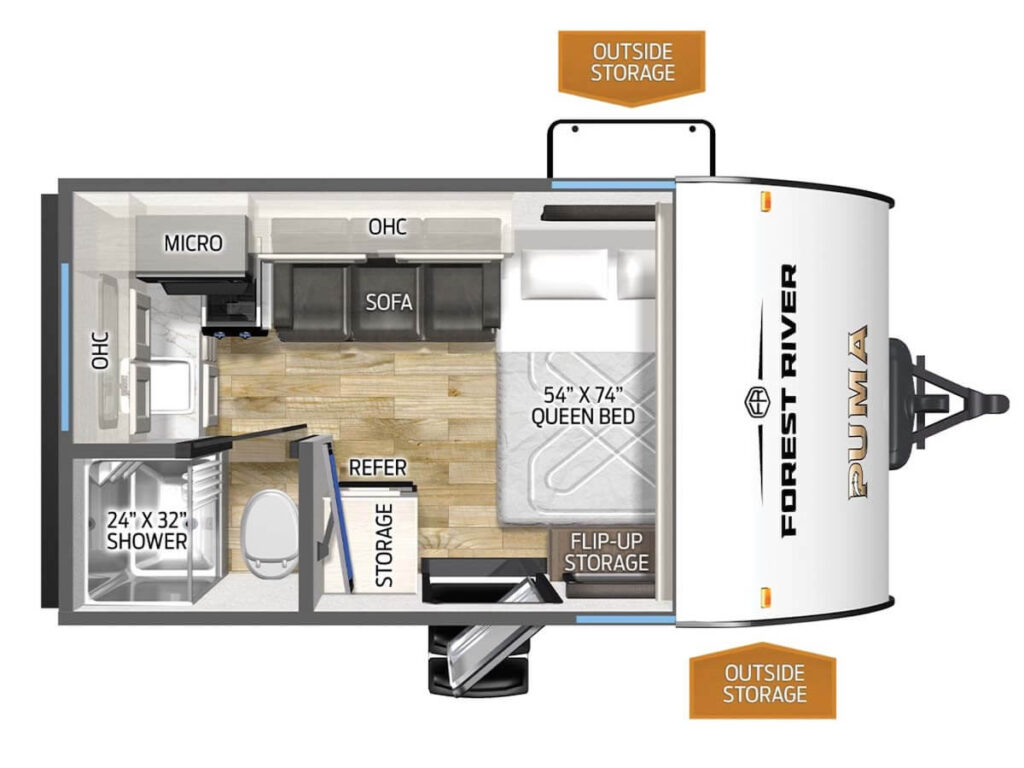
Forest River’s Puma Camping Edition is the brand’s answer to the growing demand for affordable, no-nonsense micro campers that don’t cut corners on durability. The 121RKCE is a rear kitchen layout—a configuration that puts the kitchen at the back, bedroom in the front, and a usable living space in between.
The 9-foot awning provides generous shade coverage for the outdoor setup. Inside, you get a direct-vent furnace, a full bathroom, a two-burner cooktop, and a refrigerator. The 5/8″ tongue-and-groove plywood flooring and powder-coated I-beam frame suggest this camper is built to last beyond the first camping season.
At its price point, the Puma Camping Edition 121RKCE punches well above its weight, and its Forest River pedigree means parts and service support are widely available.
Compare the Puma 123RDCE (Rear Dinette floor plan) and the 122BHCE (Bunkhouse). All three share the same 16′ footprint.
Keystone Springdale Mini 1200BT
Specs
- Length: 15’11”
- Hitch Weight: 355 pounds
- Dry Weight: 2,615 pounds
- Cargo Capacity: 885 pounds
- Sleeps: Up to 2
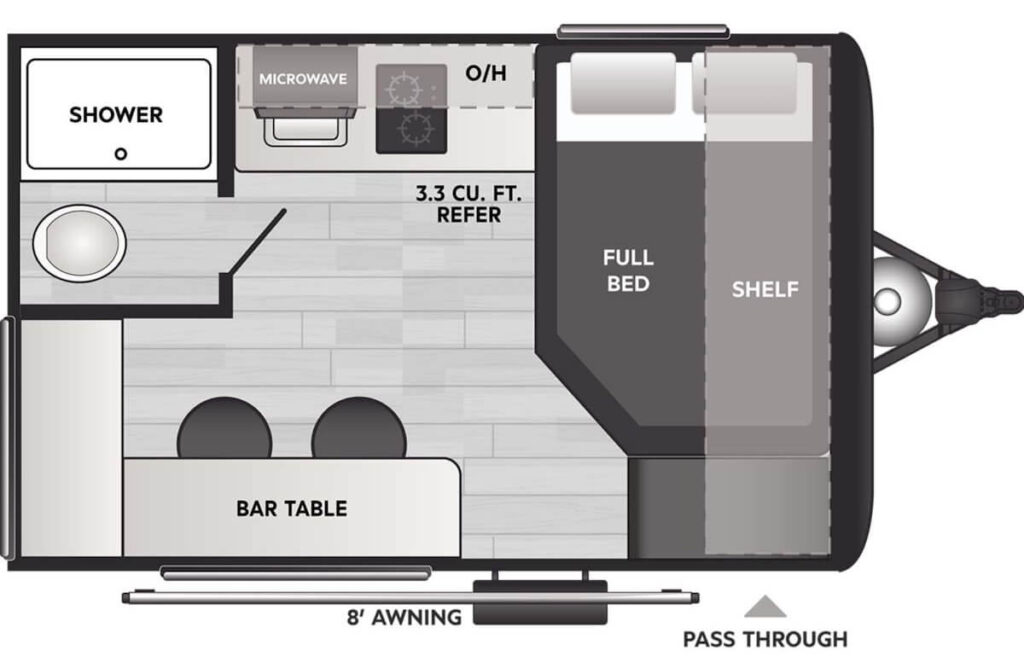
Keystone’s Springdale Mini line has built a loyal following among new RVers and budget-conscious buyers, and the 1200BT is the newest and most compact member of that family. It’s one of the most affordable full-featured micro campers available in 2026.
A new floor plan for 2026, it’s still built with many of Keystone’s reliable staples (like color-coded unified wiring) and backed by their trusted warranty (3-year limited structural; 1-year limited base). Inside, you get an 8,000-BTU roof A/C, a tankless water heater, a 12V refrigerator, a microwave, a two-burner gas cooktop, and blackout night shades. The 8′ power awning with LED lights and SolarFlex solar prep makes it easy to expand the rig’s capabilities over time.
For buyers who want a name-brand micro camper with solid warranty coverage at a low possible entry price, the Springdale Mini 1200BT makes a strong argument.
Compare the Springdale Mini 1230BB (bunk bed layout) and Keystone’s Hideout Mini 123BB and 120BT—the Hideout-branded version of the same ultra-lightweight platform.
Forest River Wildwood FSX 135ICE
Specs
- Length: 16’
- Hitch Weight: 365 pounds
- Dry Weight: 2,504 pounds
- Cargo Capacity: 1,361 pounds
- Sleeps: Up to 3
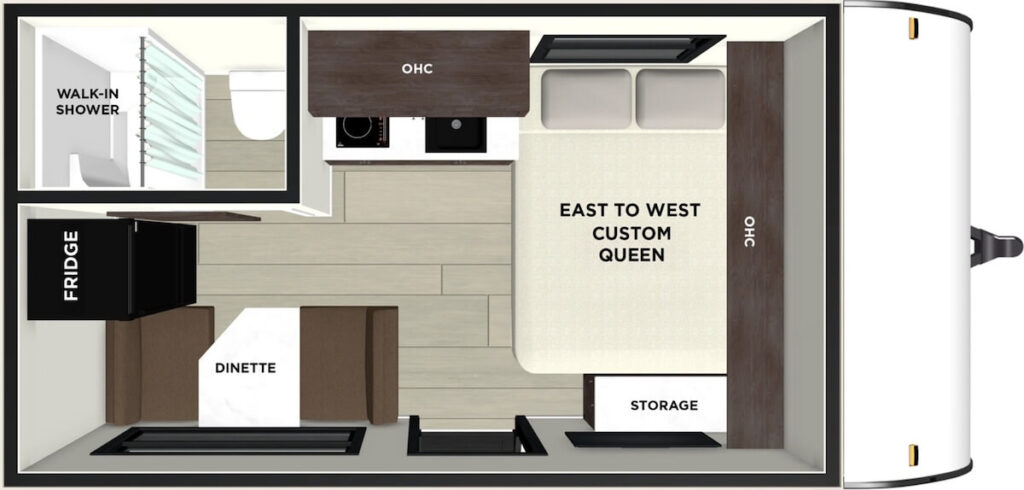
The Wildwood FSX 135ICE is a standout in this lineup for one reason: it narrowly beats the Coleman 13B to claim the title of the lightest fully-featured micro camper on this list. Combined with a generous 1,361 pounds of cargo capacity, it makes it easy to load up gear and water while remaining well within the tow ratings of most mid-size SUVs.
The FSX 135ICE boasts solid construction for its size—walkable roof, full-length frame outriggers, powder-coated I-beam frame, 5/8″ tongue-and-groove plywood floor decking, and Forest River’s SuperFlex roof membrane. The Premier Partner package adds a 60,000-BTU tankless water heater and their “Accessibelly” underbelly system for improved climate and debris protection.
A practical layout puts everything you need within reach without overcomplicating the camping experience. If your priorities are lightweight towing and easy camping, the FSX 135ICE makes a compelling case.
Same floorplan, different brand: The Salem FSX 135ICE is the identical unit sold under Forest River’s Salem FSX branding. Dealer availability may vary by region.
Other Micro Campers to Compare
Benefits of Micro Campers
Micro campers aren’t just smaller—they’re fundamentally different in how you use, maintain, and move them. Here’s what that looks like in practice:
Tow With Your Current Vehicle
Most micro campers weigh between 1,500 and 3,500 pounds, putting them within the tow rating of nearly every midsize SUV, crossover, and half-ton truck on the road today. No diesel upgrade, no special tow package, no second vehicle purchase required. For many buyers, the micro camper is the first RV they’ve owned that didn’t require buying a truck first.
Lower Ownership Costs
Fewer components mean fewer things to break. Micro campers have simpler plumbing, smaller holding tanks, and more straightforward electrical systems than full-size travel trailers. Annual maintenance tends to be significantly cheaper, parts are lighter and less expensive to replace, and most small repairs are realistic DIY projects for a weekend afternoon.
Better Fuel Economy On Every Trip
Towing adds aerodynamic drag and weight—and the heavier the trailer, the bigger the hit to your MPG. The lightweight, compact profile of a micro camper results in a much smaller drop in fuel efficiency than that of conventional travel trailers, which can cost 30–50% of your normal highway mileage. Over a full camping season, that difference adds up.
Store It at Home
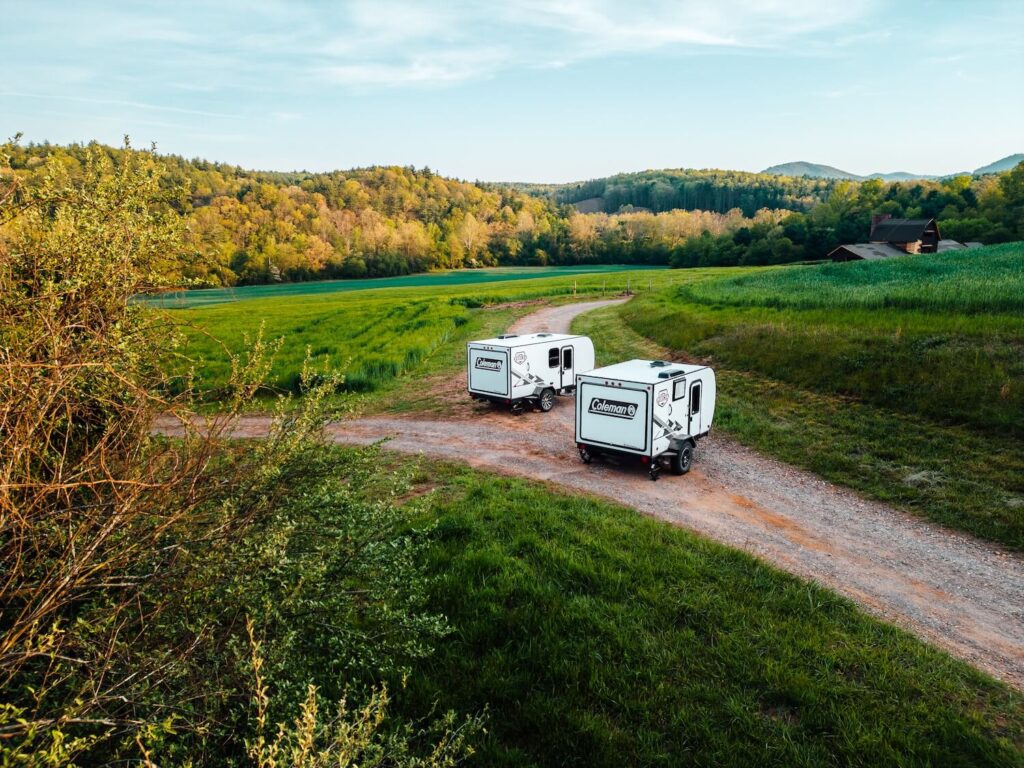
At 10 to 16 feet long (with options under 7 feet tall), most micro campers can be stored at home — either next to your house or inside a standard residential garage. No monthly storage fees, no seasonal drop-offs, no driving across town to pick it up when the weather finally breaks on a Friday afternoon.
Access Campgrounds Larger Rigs Can’t
Narrow forest service roads, older state park loops, primitive dispersed sites—these are places a 30-foot travel trailer simply can’t navigate. A micro camper opens up a whole new class of campsite, including off-grid and boondocking locations that most RVers never see.
More Time Outside
A micro camper is intentionally minimal inside. That’s a feature, not a limitation. The smaller the indoor footprint, the more time you spend at the fire, on the trail, or on the water. It’s a form factor designed to get you outside rather than keep you in.
Better yet? Their small size makes them uniquely customizable, and you will find micro campers built by leading RV manufacturers, hobbyists, and custom shops. So the choices are nearly endless.
Wondering how much your vehicle can tow? Look it up with Camping World’s Tow Calculator.
What Is a Micro Camper Used For?
The applications for microcampers are similarly expansive, as their low weight, easy towability, and convenience mean you can travel and park almost anywhere. Here’s a breakdown of how different types of RV owners might enjoy the best micro camping trailers:
Solo Adventurers and Weekend Warriors
For a single person or a couple looking to maximize trips per year, a micro camper is the lowest-friction option. You can pack, hitch, and leave in under 30 minutes. Smaller holding tanks to empty, fewer slide-outs to retract, and an easier leveling ritual. If a free Friday afternoon opens up, you go.
Couples Who Camp Regularly
Most micro campers sleep two adults comfortably—often with a queen-size or convertible king bed. The tight footprint means you’re spending your time outside rather than inside, which is usually the whole point. For couples who camp 10 to 20 weekends a year, the low cost of entry and easy towing make micro campers hard to argue against.
First-Time RV Owners
Micro campers are the gentlest entry point into RV ownership. The purchase price is low, the learning curve for towing is manageable, and if you decide RVing isn’t for you, the used market is active, and values hold reasonably well. Many first-time buyers start here and upgrade after a season or two—or don’t, because they love it.
Hikers, Cyclists, and Gear-Focused Campers
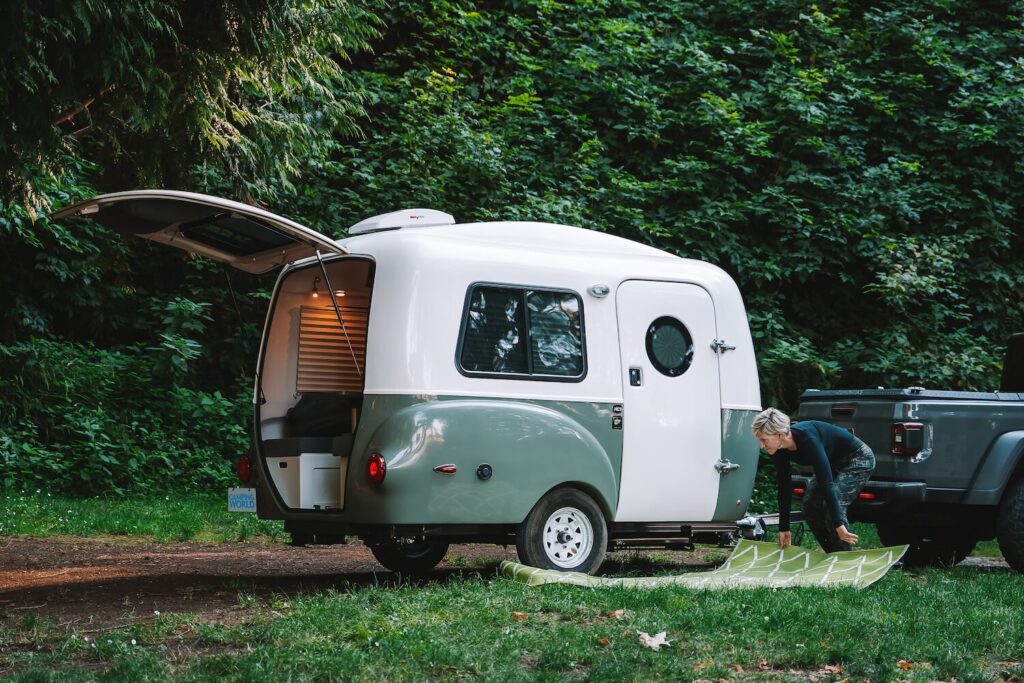
If your campsite is a base for trailheads and not a destination in itself, a micro camper is the right tool. It’s a dry, climate-controlled place to sleep and store gear between days on the trail, the water, or the bike path. Nothing more, nothing less—and that simplicity is the whole appeal.
Occasional Campers Without Off-Site Storage
Not everyone has a storage facility or a large property. Micro campers are one of the few RV categories with models that realistically fit inside a residential garage (and certainly more easily next to your house), making them practical for people who camp several times a year and can’t justify paying for off-site storage year-round.
Boondockers and Off-Grid Campers
Several of the micro campers in this article are equipped with solar panels, lithium-compatible converters, and generously sized fresh water tanks designed for dry camping. Their lightweight, compact footprint means they can reach remote, dispersed sites on forest service roads that full-size rigs can’t navigate.
Microcampers also suit occasional campers who appreciate a low profile. They are easy to store at home without taking up too much space or requiring much maintenance. They are also great for anyone looking for one of the most affordable RVs.
What Vehicle Can Tow a Micro Camper?
Quick Answer: Most micro campers weigh between 1,500 and 3,500 pounds, which falls within the tow rating of nearly every midsize SUV, crossover, and half-ton truck. You do not need a heavy-duty pickup to tow one. Many models in this article can be pulled by a Honda® Pilot, Toyota® 4Runner, Ford® F-150, or similar everyday vehicles.
One of the most common questions micro camper shoppers have is whether they need a truck before buying a camper. For micro campers, the answer is almost always no. Here’s how it breaks down by vehicle type:
| Vehicle Type | Typical Tow Rating | Models in This Article It Can Handle | Verdict |
|---|---|---|---|
| Compact SUV (CR-V, Escape, Outback) | 2,000–3,500 lbs | Bontrager Drifter 10ROK (1,700 lbs), Coleman 13B (2,506 lbs) at or near limit |  Works for lighter models — verify your trim’s rating Works for lighter models — verify your trim’s rating |
| Midsize SUV (4Runner, Pilot, Traverse) | 3,500–5,000 lbs | All 8 models in this article with comfortable margin | Ideal match for most micro campers |
| Half-ton truck (F-150, Ram 1500, Silverado) | 7,000–13,000 lbs | All 8 models — substantial margin to spare | More than capable |
| Minivan (Odyssey, Sienna, Pacifica) | 3,500–3,600 lbs | Coleman 13B (2,506 lbs), Drifter 10ROK (1,700 lbs), Wildwood FSX (2,504 lbs) | Works for models under ~3,000 lbs with tow package |
| Compact crossover (RAV4, Forester) | 1,500–3,500 lbs | Lightest models only — check your specific trim’s rating carefully |  Possible for lightest models — always verify Possible for lightest models — always verify |
The practical rule of thumb: don’t tow more than 80% of your vehicle’s maximum tow rating when loaded. A vehicle rated at 5,000 pounds should be paired with a trailer whose GVWR stays under 4,000 pounds. Every micro camper in this article fits comfortably within that threshold for a midsize SUV or larger.
Not sure what your vehicle can tow? Use Camping World’s free Tow Guide to look up your year, make, model, and trim in about 30 seconds.
How Much Does a Micro Camper Cost?
Quick Answer: New micro campers typically range from about $10,000 to $30,000 MSRP, depending on size, features, and manufacturer. Entry-level models start around $10,000 to $18,000. Mid-tier feature-rich models run $18,000 to $26,000. Used micro campers can be found for $7,000 to $15,000, depending on age and condition.
Micro campers are among the most affordable RV categories you can buy new. Here’s how the market breaks down, using the models featured in this article as real-world reference points:
| Tier | MSRP Range | Example Models (from this article) | What You Get |
|---|---|---|---|
| Entry-Level | $10,000–$18,000 | Coleman 13B/13R/13S, Springdale Mini 1200BT/1230BB, Wildwood/Salem FSX 135ICE, Drifter 10ROK, Catalina Summit 134BHX/134RKX/134RDX, Hideout 123BB/120BT | All-electric or basic platform, single axle, SUV-towable. Good for first-time buyers. |
| Mid-Range | $18,000–$24,000 | Transcend One 131DL, Puma 121RKCE/123RDCE/122BHCE, Coleman 13T | Full bathroom, upgraded appliances, solar prep, name-brand construction. |
| Feature-Rich | $24,000–$30,000 | Rockwood Geo Pro 15TB, Flagstaff E-Pro | Premium construction, 600W solar prep, queen bed, tankless water heater, superior warranty. |
| Used Market | $7,000–$15,000 | 2–4 year old examples of models above — active secondary market | Significant savings. Inspect systems carefully; micro campers are often well-maintained. |
*Prices based on available ClearPrice data for Camping World inventory as of early 2026.
A few things worth knowing before you shop:
- MSRP vs Transaction Price: Negotiation on micro campers is common. Deal prices typically below MSRP, especially on prior-model-year units or units that have been on the lot a while.
- Financing: RV loans are widely available for micro campers. At $15,000 to $25,000, monthly payments on a 10-year term with good credit typically run $150 to $300/month.
- Total Cost of Ownership: Factor in a hitch installation ($200 to $500 if your vehicle doesn’t have one), annual registration, insurance ($200 to $600/year for a micro camper), and occasional maintenance.
- Used vs New: A 2 or 3-year-old model in good condition typically sells for 60 to 75% of its original MSRP—a meaningful discount for buyers who want a specific floor plan without paying new-unit prices.
Ready to shop? Browse micro campers to see what fits your budget.
Micro campers are a great way to explore. They’re perfect for new RVers and those looking to optimize their time on the road. Downsizing has never looked better than when buying a micro camper. To help your search for a small camper, consider the following resources:
- Looking for the Smallest Camper?
- What Is the Best Small RV?
- Low Cost Travel Trailers You’ll Love
- Check out These Small Campers with Bath
What features are you looking for in a micro camper? Tell us in the comments!
The post Awesome Micro Campers You Shouldn’t Overlook appeared first on Camping World Blog.
This is a companion discussion topic for the original entry at https://blog.campingworld.com/find-your-rv/3-awesome-micro-campers-you-shouldnt-overlook/